Mayor approves Broadway streetcar, wants transit on 12th

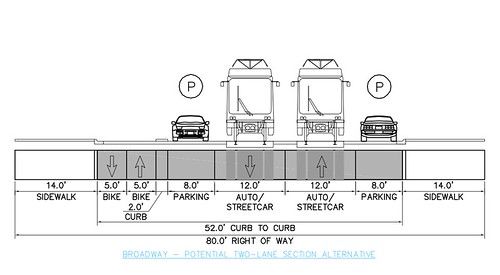
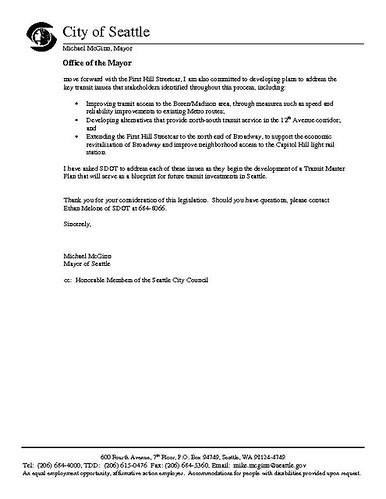
Today Mayor Mike McGinn put his stamp of approval on SDOT’s choice of Broadway as the main north/south route of the First Hill Streetcar. In a letter to the City Council (attached at left), the mayor cited that alignment’s low cost and opportunity to “re-think the Broadway streetscape” as the main advantages of the Broadway option, vs. other alternatives to the east and west of that street.

The Broadway/Jackson route is estimated to cost approximately $125 M, comfortably within the maximum Sound Transit funding limit of $132.8 M, and will provide an efficient and accessible new transit option. The route also presents opportunities to re-think the Broadway streetscape in ways that support walking, biking and riding transit. In the Chinatown/International District, the Pioneer Square loop integrates well with other transit and connects First Hill and Capitol Hill to this historic district and the adjacent stadium district.

The next step is for the City Council to give their approval before detailed design and contracting can commence on the project. Construction is scheduled to start next year, with service opening in 2013.

But if there’s one consolation prize to those who were pushing for the 12th Avenue options, it can be found in the next paragraph of the mayor’s letter, where he says that he is committed to improving transit on other streets around broadway:

  • Improving transit access to the Boren/Madison area, through measures such as speed and reliability improvements to existing Metro routes;
  • Developing alternatives that provide north-south transit service in the 12th Avenue corridor; 
  • Extending the First Hill Streetcar to the north end of Broadway, to support the economic revitalization of Broadway and improve neighborhood access to the Capitol Hill light rail station.

Those improvements will be studied as part of the forthcoming Transit Master Plan. But no date or funding sources are mentioned so far.

Here’s the details of the streetcar route, which includes a loop up to 14th Avenue to connect Broadway with Jackson:

  • A tail track for inbound and outbound trains on E Denny Way, from the vicinity of 10th Avenue E to Broadway, provided that the tail track section may not be constructed if a route extension is approved prior to the construction of the First Hill Streetcar Project;
  • Northbound and southbound tracks on Broadway, from E Denny Way to Yesler Way;
  • Eastbound and westbound tracks on Yesler Way and E Yesler Way, from Broadway to 14th Avenue S;
  • Northbound and southbound tracks on 14th Avenue S, from E Yesler Way to S Jackson Street; 
  • Westbound tracks on S Jackson Street, from 14th Avenue S to 2nd Avenue S; 
  • Northbound tracks on 2nd Avenue S from S Jackson Street to S Main Street; 
  • Eastbound tracks on S Main Street from 2nd Avenue S to 5th Avenue S;
  • Southbound tracks on 5th Avenue S from S Main Street to S Jackson Street; 
  • Eastbound tracks on S Jackson Street from 5th Avenue S to 14th Avenue S.


View 1st Hill Streetcar – “Two-way Broadway” in a larger map
Feet First comes to the ‘hood; a Q&A with Executive Director Lisa Quinn

This Wednesday, April 7, the Leschi Community Council will focus on walkability.  For a preview of the 7:30 p.m. program at the Central Area Senior Center, LeschiCC interviewed Feet First Executive Director Lisa Quinn.

Leschi CC:What’s the most important thing for CD News readers to know about pedestrian-issue policy and politics in Seattle right now?

Lisa Quinn: This past fall, the City of Seattle passed its first Pedestrian Master Plan. The plan outlines ways the City will reach its goal to become the most walkable city in the nation. The most critical part of the plan is to have designated funding for implementing the different elements.

Last month, Feet First signed on to a letter with other organizations which was sent to Seattle City Councilmembers addressing the need to ensure the planning design for Washington Department of Transportation’s proposed tunnel project in downtown moves full speed ahead with a robust oversight to ensure Seattle’s interests are protected. It is important for community representatives to know this project is happening and leadership by the City is important to support the pedestrian environment on the waterfront.

Leschi CC:What can we do to make our neighborhood a better place to walk?

Lisa Quinn: One of the simple ways is just getting out and walking. As a voice for promoting walkable communities, Feet First has a lot of tools community groups can take advantage such as walking audits and our new Neighborhood Walking Ambassador Program . http://feetfirst.info/Walkingambassador.

I invite community representatives from Leschi to take advantage of an upcoming free Neighborhood Walking Ambassador training being held on Saturday, June 10th from 10am-12pm in West Seattle designed for engaged, passionate community members interested in leading walks in their neighborhoods. The walks build on neighbor to neighbor action identifying ways to create more walkable communities.

For more information or to register for the Neighborhood Walking Ambassador training, contact Feet First by emailing [email protected] calling 206-652-2310

Leschi CC: You personally endorsed Mayor Mike McGinn in his candidacy as Mayor.  What are your hopes for pedestrian issues in Seattle during his term?

Lisa Quinn: During his term, I hope the City of Seattle will take transportation seriously and invest in walkable communities. Mayor McGinn’s proposed Walk, Bike and Ride campaign is a great start to becoming the most walkable city in the nation. Pedestrian improvements are crucial thread to many pieces of transportation. There must be an integrated approach in supporting walkable communities. A few issues I hope his administration will address include:

  • Redistribute funding to support high need areas;
  • Identify travelsheds to address how people travel and to leverage transportation dollars;
  • Reach new citizen groups rather than the usual suspects; and
  • Measure projects on their impact on the pedestrian improvements. For instance addressing how the tunnel project will affect the Level of Service for the pedestrian environment has not been discussed, rather only the Level of Service for vehicles. We need to re-prioritize what we measure if we are truly trying to have walkable communities not drivable communities.

Leschi CC: Safe Routes to School—how safe can they be?  Why should kids bike or walk to school?  Isn’t it dangerous?

Lisa Quinn: Since 2005, Feet First has been working on Safe Routes to School programs locally and statewide. With the upcoming Neighborhood Schools policy in Seattle, schools have an opportunity to embrace active transportation as a legitimate and important way for students to arrive at school.

Every child should have a safe place to walk to school, to the library, to a park. At Feet First we recognize the importance of Education, Encouragement, Engineering, Enforcement and Evaluation to create a safe route to school. Over the last 30 years the number kids walking and biking to school has reduced from 66 percent to 13 percent. In that same time, obesity rates have dramatically increased. To make it safe for students to walk to school, Feet First developed a pedestrian safety curriculum which gives every student in a K-5 environment hands on information on how to be a safe pedestrian.

Leschi CC: What will we see on Wednesday night at the Leschi Community Council meeting?

Lisa Quinn: Join us on Wednesday night for entertainment by students in the Central District as they share with the community their interpretation of public space and walkable communities through videos they personally created. We’ll also show the Safe Routes to School documentary, which highlights three schools and how Feet First has used the program to increase the number of students walking. The videos provide an opportunity for inspiring reflection and conversation, which will support creating walkable communities throughout Seattle.

Parks funding in trouble, possible closures, service cuts

The city faces a budget shortfall of $60 million over the next two years, and supporters of the city’s parks system are raising alarms that the parks department could see the largest impacts.

In an note sent to a neighborhood email list, Adrienne Bailey, board member of the Associated Recreation Council, says that parks supporters are “in absolute crisis mode”, and asks for other residents to speak out ans support retaining park funding:

We are people who take great pride in our Parks, open space, Community Center and other facilities and make good use of all of them.  We really need everyone to stand together and raise our collective voices.  These are our Parks and Recreational facilities, we must tell the Mayor and City Council that the buck should not stop at Parks & Recreation, nor do we want the City to balance its budget on the back of Parks & Recreation.  These cuts cross all generations, races, socioeconomic backgrounds and families.  Most important of all we at putting positive activities for our youth as major risk.  We are still in a battle to rip our young people from the negative groups, activities and behaviors they have fallen in with. 

But this morning our friends at Capitol Hill Seattle are reporting anonymous sources who say the decisions have already been made and the cuts are are the way:

While none of the major planned cuts have been confirmed by Parks or the city, CHS received confirmation from a City employee with knowledge of the situation who asked to remain anonymous about the severity – and certainty – of the cuts being planned.

“Overall, I’ve been told in meetings that everything, including pools, community centers and environmental centers in all parks and open spaces will receive dramatically less attention,” said the employee. “Parks facilities and [public] open spaces will be considered for cuts and reductions in service. This is unprecedented, to my knowledge.”

“It’s too early to know,” said Dewey Potter, Communications Manager for Seattle Parks and Recreation. “Parks and Recreation will certainly share in the reductions needed to make up for that [$50 million] shortfall. The City Budget Office [CBO] has not yet issued its 2011 budget instructions to departments. When we receive them around the end of April, they will be based on the latest revenue forecast and a target budget number for each department.”

The anonymous employee, however, said that the cuts are already a done deal and that Parks is already planning the reductions.

“To my knowledge there are no more votes on this, and the decisions are final,” said the employee.

Your next chance to speak directly to city leaders will be at a public hearing on the city budget on April 28th.

Update: The Parks Department is reacting strongly to CHS’s anonymous source who said that the decisions on cuts have already been made. Here’s the full response from Joelle Hammerstad in the Parks Department communications office:

Please stop reporting that Parks budget cuts are a “done deal.” I can tell you unequivocally that they are not. The Superintendent has said repeatedly that “everything is on the table.” In fact, I just spoke with him this morning, and he reiterated it again. 

While I hesitate to conjecture about what meetings the anonymous employee is referring to, it is possible that he/she is talking about potential budget scenarios that the department is considering. This is a normal part of the budget cutting process. We have not yet received directions from the City Budget Office (CBO) regarding our target reductions; however, we anticipate that we will have to make mid-year reductions, as well as 2011 reductions. 

To wait until after we receive direction from CBO to begin considering where we will make those reductions would be nothing short of careless. It is our responsibility to the taxpayers to begin having conversations internally about where we can fill the budget gap. Pool and community center closures are being considered, but so is everything else.

City planning fixes for Leschi sewer overflows by 2018

The city’s sewer system was much simpler one hundred years ago. It basically left your house, ran downhill in a pipe, and then across the Lake Washington shoreline and into the lake. Whether it left a toilet or rainfall into a roadside drain, it all traveled through the same pipes and ended up in the same place.

The most basic of treatment didn’t arrive until the 1920s, and the bulk of the problem wasn’t cleaned up until King County Metro was approved in the late 1950s, by which time Lake Washington had turned into a polluted, algae infested mess. Those improvements intercepted the many outfalls along the lake and Puget Sound, and pumped them into new pipes that carried the waste to new secondary treatment facilities in Renton and at Fort Lawton.

But the fixes weren’t without their own problems. Many street drains still run into the sanitary sewer system. But the pipelines and pumping stations have fixed capacities, and can become overwhelmed during heavy rains. And machinery in pumping stations or pipline valves can break down too. Any time those things occur, the backup plan is to reactivate the old lines into the lake, resulting in millions of gallons of untreated sewage being dumped into Lake Washington each year.

But now the city is developing a plan to fix the remaining problems and drastically reduce the overflows. Seattle Public Utilities is finalizing the 2010 Combined Sewer Overflow Reduction Plan that will plan a fix for a major overflow basin in Leschi. But it’s a long-term project. According to SPU spokesperson Andy Ryan, the terrain in Leschi combined with the density of the neighborhood will push the project completion date out to 2018.

Leschi isn’t the only overflow site along our section of the lake. A similar outfall exists near Madrona Beach, just north of the the turn-around for the #2 bus.  The city estimates that resolving all CSO issues would cost upwards of $600 million, and will have to be funded through some mix of sewer rate increases and federal funding. The next step is the development of a Long-term Control Plan that will identify all of the problem areas and prioritize them based on volume and frequency of their discharges.

In the meantime, you might want to think twice before going for a swim in the lake after a major rainstorm.

Big crowd of kids at egg hunt

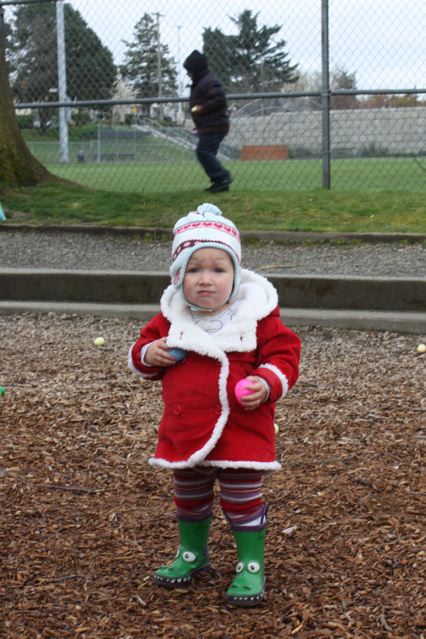
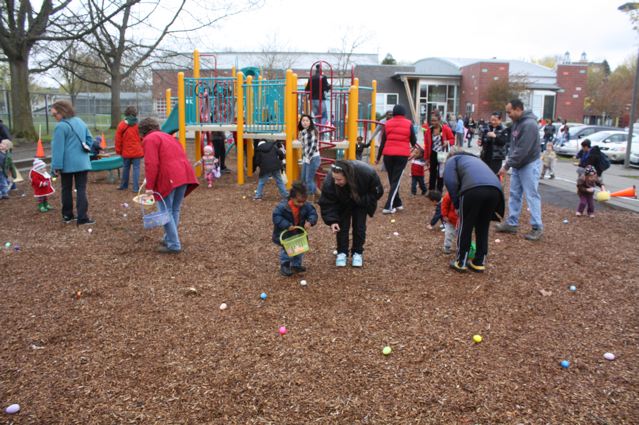
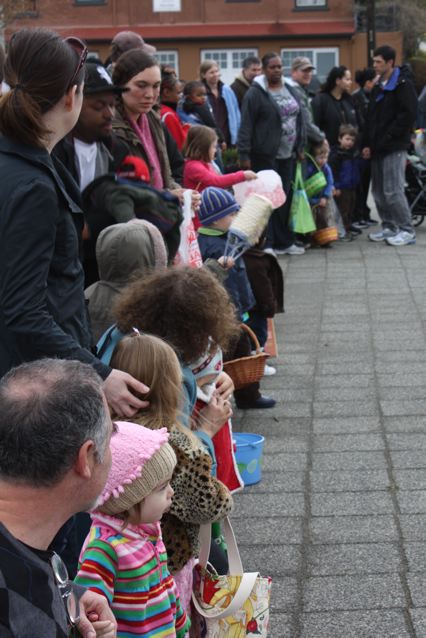
This morning about 80 kids braved the unseasonably cold wind and converged on the Garfield Community Center for the annual egg hunt. Candy was the most common reward inside the plastic eggs, but a few lucky hunters found special prizes in theirs.

Here’s some photos, courtesy of jseattle at Capitol Hill Seattle:

Tomorrow: Teamwork at 23rd & Union gets you free pizza

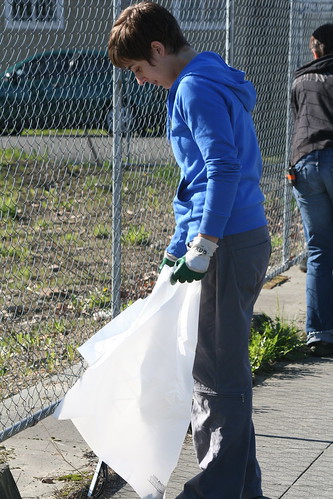
Neighbors and businesses around 23rd & Union are impressively organized this year, cleaning up, painting over graffiti, and now they’re getting ready to spruce up the community garden there for Spring.

If you join in the fun tomorrow (Saturday), 1pm-4pm, you’ll earn free pizza and beer courtesy of Central Cinema (a CDNews sponsor). 

Organizers say to come prepared with gloves, shovels, and trash grabbers. They’ll have the bags for trash & composting, the plants, and instructions on where to put them.

And no worries about the weather. Jean Tinnea tells me that it’s happening rain or shine.