About Tom Fucoloro

As former editor of CDNews, Tom still helps out with coverage now and then.

Two weekends left for the Central District Civil Rights walking tour

You have two more chances to go on a walking tour of the Central District’s Civil Rights history. Hosted by the Museum of History and Industry (MOHAI) and the Northwest African American Museum (NAAM), the two-hour walking tours will explore places throughout the neighborhood that were important during the 1960s Civil Rights Movement.

The tours are being held in conjunction with the Freedom Riders exhibit at MOHAI through October 24, which is hosted in part by CD Forum.

The two remaining walks are October 15 and 22. Tickets are $10 (or $5 for MOHAI members). They can be purchased in advance online.

From MOHAI:

Neither the Civil Rights Movement of the 1960s nor the racially discriminating practices that fueled it were limited to the Deep South. In Seattle, de facto housing segregation confined the majority of the city’s African American residents to the Central District and racial inequality was widespread in schools and in the workplace. The Central District neighborhood was a hotbed of activity in the 1960s, as men and women working or living in the area led the local Civil Rights Movement. Explore this rich history on a two hour walking tour, led by docents from the Museum of History & Industry and the Northwest African American Museum.

This program is offered in conjunction with the exhibit Freedom Riders, on view at MOHAI September 26 through October 24. It is presented by the Museum of History & Industry and the Northwest African American Museum.    

Meet at: Langston Hughes Performing Arts Center, 104 17th Ave. S. This walking tour will cover about 1.5 miles; please wear appropriate shoes. Tour will end approximately half a mile from the starting point.

The Seattle Times recently featured the walks:

“I think that people will really kind of connect more through the walking tours,” MOHAI communications director Jackie Durban said. “We really wanted to bring history out into the streets, outside of the building and personalize and highlight a local connection to Seattle.”

The tour makes 10 stops throughout the Central District, each of which was significant during the civil-rights movement. On the itinerary are Garfield High School — where black activist Stokely Carmichael spoke to an audience of 4,000 in 1967; the Douglass-Truth Library, home to one of the largest collections of African American literature on the West Coast; and the Central Area Motivation Program — launched during the civil-rights movement and instrumental in creating initiatives to provide housing, employment and food programs throughout Seattle.
CHS: Madison Park considers new beach


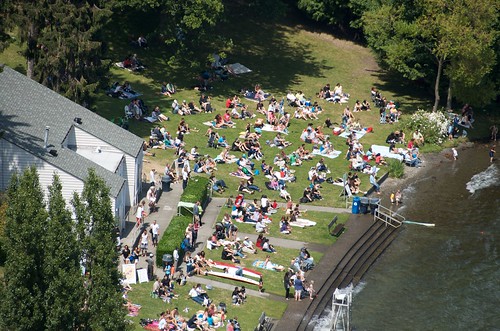
Madison Park Beach, originally uploaded by thenewamtrak.

It will be summer again, someday. And CD residents could have a little more public beachfront nearby if a plan to tear down a Madison Park Beach fence goes through, our sister site CHS reports.

The Seattle Parks Board is considering a proposal to open up the shoreline on park land just north of the popular beach — a public hearing is scheduled for early November.

The Madison Park Blogger says the neighborhood, in a theme that seems to define Seattle living as the city’s population grows and density increases, is torn:

While we may really be the elitist, keep-it-all-to-ourselves kind of neighborhood that our detractors claim we are, I’d like to think we’re better than that.


The choice before us, I believe, is this: Do we as a community wish we were more like our exclusive enclave, Broadmoor, with its perimeter walls and gate guards? Or are we a neighborhood that believes in sharing with other Seattleites the very amenities that help make this Village by the Lake a joy for those of us lucky enough to live here?

Read more at CHS.

Here’s the meeting poster:

madison_11x17_11.3.11

UW features 6,000-square-foot garden at Monica’s Village Place

The University of Washington posted a news brief recently about the garden at Monica’s Village Place, a Catholic Community Services housing project at 23rd and Main. The 6,000-square-foot garden was created with the help of UW Professor of Landscape Architecture Daniel Winterbottom and 12 of his students.

They also produced a video, featuring some of the people involved with the project (note: you may need to crank the volume):


From UW:

For four years, the garden at Monica’s Village Place was no more than a dream and a Post-It note tagged to Evelyn Allen’s computer.

Today, though, the garden runs the width of a block at 23

rd Avenue South and South Main Street in Seattle’s Central District. It’s the centerpiece of a new low-income housing complex built by Catholic Community Services.

Daniel Winterbottom, a UW professor of landscape architecture, and 12 of his students worked with Allen, director of Catholic Housing Services Village Spirit Center, and a group of her residents, to design and build the 6,000-square-foot garden.

“I wanted a place where families could unwind,” said Allen, director of Monica’s village, which includes 51 apartments ranging from studios to three bedrooms.

Named after the mother of St. Augustine, Monica’s Village houses black Americans who have been homeless or at risk of being so. Catholic Community Services wants to decrease homelessness via a package of support services that go with apartment rentals.

To rent an apartment, the person must first have a dream, indeed real desire, to change whatever prevents him or her from having a stable life. And a garden can be a place to encourage that desire, to reconstitute oneself and one’s family, said Winterbottom, who specializes in therapeutic gardens.

The garden at Monica’s Village includes three “rooms”: a play space with a rubberized floor; a gathering area with benches and cooking space; a quiet arbor tucked away at the rear.

To encourage community pride, pictures and quotations from people well known in the black community, people like jazz musician Quincy Jones, have been stamped onto brushed stainless steel pillars and planted around the garden. A map of the Central District with key African-American places such MLK Way and the Douglass Truth Library is painted onto the playground surface.

The garden has turned out well, but designing and building in a third-floor courtyard was a challenge, Winterbottom said. Nothing, for example, could be massively heavy because the garden sits atop a parking garage. And since watering must be done by hand, plants had to be drought-resistant. There also needed to be both communal and individual gardening space. A series of raised beds have been set aside for the community, and galvanized metal tubs have been assigned to individual residents.

Several months after the spring dedication, Winterbottom returned to the garden. Surveying the work, he said, “A house is a roof over your head. A home is a community, a place to encourage that desire for community and a place to nurture it.”

City Council resolution calls for district energy framework

The City Council approved a resolution to move forward with the creation of a framework under which district energy could operate, citing Yesler Terrace as the most likely candidate for the first project. The study would look specifically at how legal contracts between the city, energy providers, operators and customers could work, bringing the creation of such a system one step closer.

As we reported in July, a recent feasibility study showed Yesler Terrace and First Hill as the best candidates for a new district energy system. With the pending large-scale redevelopment of Yesler Terrace on the horizon, the city’s Office of Sustainability and Environment (OSE) sees a unique opportunity to get the system installed in conjunction with other road and building work.

A district energy system consists of a series of underground pipes carrying energy, typically in the form of steam or hot water, that buildings can pull from for their heating needs. Getting the pipes in the ground is a significant cost unless it can be done in conjunction with other road and building work. Results from modernized systems all over the world have shown district energy to be more efficient and more versatile than systems where individual buildings take care of their own heating.

From the City Council:

Today, the Council unanimously adopted Resolution 31329, supporting the efforts of the Office of Sustainability and Environment (OSE) to create a framework for a district energy system for the First Hill/Yesler Terrace area. 

“District energy systems are one of the most effective ways to provide affordable and clean energy for heating and hot water,” stated Council President Richard Conlin, Chair of the Regional Development and Sustainability Committee. “Generating energy in a central location and distributing it to nearby areas is much more efficient than having separate heating units in each building.”

The resolution calls for OSE to work with other City departments, non-City agencies, and entities with technical, financial, legal, or other expertise, to generate key information to provide the framework for proceeding into the next stage of district energy development. OSE is asked to review these approaches:

1.    A “strategic district energy partnership” which the City would drive through contracts with private companies that deliver the district heating services.

2.    Creating a smaller, stand-alone district energy system for Yesler Terrace which could possibly be expanded in the future.

3.    Creating a municipal heating district. 

Currently, Seattle’s downtown is served by a system for heat and hot water to some 200 buildings. Last year, OSE reviewed the opportunities for new and expanded district energy systems around Seattle. Based on that study, OSE recommends moving forward with planning to expand district energy systems on First Hill, including at the new Yesler Terrace redevelopment.

OSE recommends that the City move forward with creating a legal framework and contracts for utility service in 2012. OSE also recommends exploring promising future opportunities in Capitol Hill, South Lake Union and the University District.

Background: Seattle is one of the fortunate cities around the world that already has a very well functioning district energy system, operated by Seattle Steam Company, and serving some 200 buildings downtown and on First Hill.  Seattle Steam has been operating its system for 115 years. Energy analysts around the world have begun to understand how efficient and clean district heating systems can be and as Seattle Steam has taken on a new importance, the company has invested in new technologies to reduce pollution and greenhouse gas emissions and maximize the efficiency of its energy use.  The University of Washington also operates a district energy system serving campus buildings.

Woman and child steal $80 in crab from market on S King St

An adult woman and a child estimated to be between six and nine years old stole a bag of crab worth $80 from a market near 12th and King shortly before 5:30 p.m. October 5. The woman allegedly handed the boy the crab, and he walked out of the store without paying and entered a brown SUV, possibly a Chevy Tahoe. There were several others in the SUV.

When the victim confronted the suspects about the theft, a third suspect allegedly shoved the victim before the group fled in the SUV, according to the police report:


Times: Glassybaby had a unique path to success

On the heels of a story in the New York Times, Madrona-headquartered Glassybaby and its founder Lee Rhodes were featured in the Seattle Times recently. Over a meal at the Hi-Spot Cafe on 34th Ave, Rhodes and reporter Blythe Lawrence talked about Rhodes’ inspiration for the glass votive endeavor and it’s unlikely success despite going against several standards of business.

Glassybaby has seen a big rise in sales and recently added two more ovens to the Madrona shop.

From the Times:

Glassybaby’s translucent, gently curved votives now come in more than 400 colors, and last year the company’s sales jumped by half to $3.8 million.

Martha Stewart is a fan, and local celebrities, including Amazon.com CEO Jeff Bezos, have stopped into one of Glassybaby’s three Seattle-area locations to offer encouragement and admiration. Bezos was so impressed that he purchased a stake in the company.

So far this year, sales have been up more than 35 percent, and the company expects to top $6 million in 2011. To meet the continued demand, Glassybaby recently added two ovens to its Madrona hot shop, doubling potential output.

For all that, Rhodes is still slightly self-deprecating about Glassybaby’s success. “Most entrepreneurs are super smart,” she said recently over breakfast at Madrona’s Hi-Spot Cafe. “They know what they’re going to do and they have it written down in a business plan. For me it was just entirely different.”

Read more…

Seattle Transit Blog: Prop 1 and federal grants could electrify Route 48

King County Metro has outlined the funding proposal for turning Route 48 into an electric trolley bus, and it involves a combination of local and federal grants, according to Bruce Nourish at Seattle Transit Blog. The King County Executive’s proposed 2012 capital improvements budget includes the project, but it will need to find outside funding in order to happen.

A month ago, Nourish proposed a plan that would split the 48 into two routes that would meet in the University District. Metro and the City of Seattle could then install trolley wires on the southern portion of the route, from the University to Mount Baker Station along 24th and 23rd Avenues. Much of the route already has wires (used by the 43), so it’s mainly the Central District and Mount Baker portions of the 48 Route that need them.

Total estimated cost to electrify the route is $13 million, much of which would have to come from the City of Seattle. From STB:

Unfortunately, before you stand up and cheer, there’s some bad news: this project is externally funded, and the funding is a moderately-long shot. The funding sources identified in the budget are a federal grant and the City of Seattle. For this project to happen, two things must happen: Metro needs to win a $6.9 million TIGER grant, and the city must pass the $60 VLF to afford the $9 million local match. $6.9 million is at the high end of the typical range of TIGER grants, but due to the excellent and long-lasting environmental benefits and shovel-ready nature of the project, this project should be very competitive.

The total of $13 million is rather higher than I would have expected based on the conventional wisdom of roughly $3 million per mile for uncomplicated segments of wire; Metro’s spokespeople were vague on why the cost seemed so much higher. I suspect that some of the cost might come from upgrades required to existing substations and other infrastructure on 23rd Ave, which may have changed little over their several decades of use; and also the cost of paperwork and compliance that always accompanies federal dollars.

It is unlikely the city will be able to come up with their end of the project funding unless voters approve Proposition 1 in November (full disclosure: I have been advocating for Prop 1 over at Seattle Bike Blog). Proposition 1 would increase Seattle Vehicle License Fees (AKA “car tabs”) by $60. According to the planned spending structure, nearly half the funds raised would be used for transit efficiency projects (like this one) and high capacity transit planning (like the Madison rapid bus project we wrote about previously). About 30 percent would go to general road system safety, repair and maintenance. About 22 percent would go to walking, biking and freight projects.

Here’s the Route 48 project’s funding proposal from the County Executive’s proposed 2012 budget:

Swedish and Providence ‘join forces’ to form new health care non-profit

Swedish Health Services, which has a campus on Cherry Hill, has “combined forces” with Providence Health & Services, a Catholic-affiliated health care organization based in Redmond with services throughout the region.

Under the agreement, both Providence and Swedish will retain their names. Providence would retain its Catholic affiliation while Swedish remains non-religious. All facilities for both organizations are expected to remain.

The new arrangement will improve the care and affordability of care, Providence and Swedish claim in their press release.

From Swedish and Providence:

Officials from locally based Providence Health & Services and Swedish Health Services today announced plans to form an innovative affiliation that will improve health-care quality, access and affordability for the residents of Western Washington. This unique affiliation will allow both organizations, which have each served the Puget Sound area for more than 100 years, to collaborate to better deliver health care to the region while at the same time maintaining their individual identities and heritage.

Under the proposed plan, the two organizations will form a new not-for-profit health-care system that will include all of Swedish’s operations in King, Snohomish and Kittitas Counties and all of Providence’s operations in King, Snohomish, Thurston and Lewis Counties. Providence will keep the Providence name and its Catholic identity, while Swedish will keep the Swedish name and remain a non-religious organization.

Here’s the full press release announcing the deal:

10 6 11 WWHS News Release