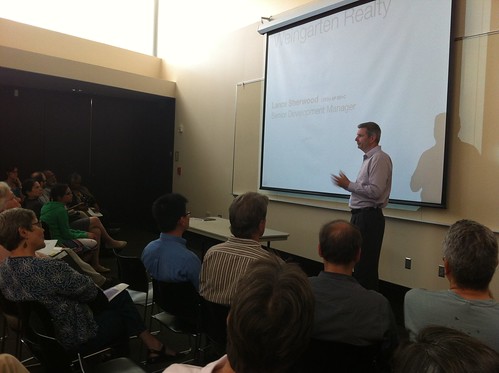
Neighbors of 23rd and Jackson packed the meeting room at Douglass-Truth Library Wednesday to open a renewed discussion about the future of the corner and its aging, never-fully-realized shopping center.
For the most part, the meeting—organized by the Colman Neighborhood Association and the new Jackson Commons group—centered around the points most neighbors can agree on. We love our locally-owned businesses and need to support them, we want more activity on Jackson Street, and we love the music they play at Red Apple. Chief among those points of agreement: No Wal-Mart, no way.
It’s not clear how the Wal-Mart rumors started. Weingarten, the Houston-based company that purchased Promenade 23 in 2011, says they have no plans to build a Wal-Mart on the property. Lance Sherwood, Weingarten’s Senior Development Manager for the Western Region, cancelled some other appointments to attend Wednesday’s meeting and briefed the crowd on the company’s history, which got its start as a grocery store. “Grocery anchor centers” are their typical developments, he said. He also reiterated that they have no plans yet.
“We want to engage with our community when we have a design,” he said. “When we have a design, you will be the first to know.”
But just the utterance of the W-word was enough to kick people into action. UFCW21, the union representing the workers at Red Apple, showed up with a strong anti-Wal-Mart message. Elene Perez, the union rep, laid out three points that she said the union and neighbors of the project should stand behind:
1: No Wal-Mart.
2: A diverse representation of community leaders in the CD should have an ongoing role in the development decisions.
3: Workers and small local businesses already working or operating at Promenade 23 need some guarantee that they will have an opportunity in the new development.
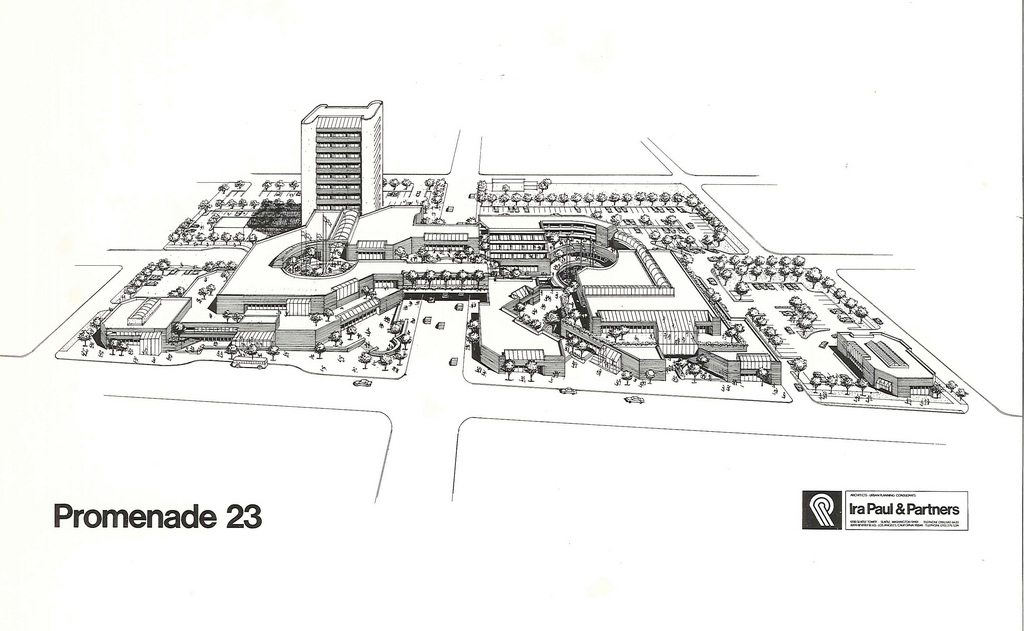 Jimmy Sumler’s Promenade 23 vision from 1970 that was never realized.
George Staggers of CADA added another point to the list: A long-term lease for the Red Apple.
Lenny Rose, owner of Red Apple, said they want to stay.
“I’ve been here all my life, and I consider it my neighborhood,” said Rose. “We are committed to being here.”
Carl de Simas of the Jackson Street Corridor Association presented about his organization’s work to create a Business Improvement Area on Jackson. Basically, the BIA would assess funds from property owners and put it into a pool that would be used to make investments in the corridor, like clean-ups, banners and community events.
One meeting attendee pointed out that the BIA funds in other neighborhoods have also been used to hire extra police, which would likely be controversial. The BIA members would decide what to do with the funding if it goes through, but there are still some significant hurdles. Currently, 40 percent of property owners in the area have signed onto the plan, but that is not enough to put the proposal in front of the City Council. Weingarten has not yet signed on, de Simas said.
The big question of the meeting was: What power do neighbors have to influence the future of Jackson?
Lyle Bicknell from DPD gave a presentation about the Design Review Board’s process. When a project is proposed, it will go to the Board for approval. While the Board’s purview is primarily architectural (they can’t do much about concerns of gentrification several meeting attendees voiced), he said the more unified the community can be in their desires, the more effective it will be in influencing the process.
“If the community can speak with, maybe not one voice, but with one direction, that can have a powerful impact,” he said. “This neighborhood has a leg up because you’re and you’re talking already.”
Obviously, the meeting did not solve the problem of gentrification.
“Sometimes, the things that make an area attractive and vibrant are the first things to get priced out,” said Bicknell. This concern was supported by several current business owners at Promenade 23 who feared they would not be able to afford a spot in a new development.
But unlike so many conversations about gentrification that happen in the neighborhood, the prospect of an out-of-state developer making decisions at the corner seemed to be a uniting force among neighbors. And Jackson Commons leader Knox Gardner insisted on focusing energy toward things we can do to have a positive and proactive community effect.
Wyking Garrett suggested that the annual Umojafest parade and festival in Judkins Park, of which he is a key organizer, is a great opportunity to support and celebrate community culture and engage more neighbors. This year’s festival is August 3-5 with the parade on the 4th.
Gardner said Jackson Commons has plans for some upcoming community events to support and highlight existing businesses. They are planning an upcoming dinner in the Promenade 23 parking lot featuring food by East Africa Imports, a Promenade 23 business. He said there will also be another “pop-up cafe” Thursday afternoon at an undisclosed location (to be announced on the Jackson Commons Facebook page).
One man talked about a trip he took to Montreal recently and how impressed he was with the success of activists there to leverage direct action, such as protests and occupations, to create community projects and get laws changed. He also suggested that community members could create some cooperative businesses to keep the wealth generated on the corner circulating as locally as possible.
“And, a little less radical, can we get a credit union there?” he asked, pointing out that there are only commercial banks in the close vicinity.
Leaving the meeting, people were tasked with talking to their neighbors (especially neighbors who don’t use the Internet) about Jackson and get them involved in the conversation. Anyone with project ideas are encouraged to email [email protected] or, of course, suggest it in the comments below (a great way to get connected with others interested in helping). Reach out to churches, groups and community events to keep the discussion going.
And, of course, head over to Jackson and support the businesses there.