
- Seattle Weekly article: “Frustrated by what they view as police indifference, a group of Beacon Hill residents takes to the streets packing heat.”
- Citizen Rain thoughts about the article, with many comments.
- Mid Beacon Hill blog: more on the topic, more comments.
Author Archives: Andrew Taylor
Seattle Times Obit: Central District photographer
The Sept. 4th Seattle Times has a very informative obituary about Al Smith Sr., who photographed the Central District: he “single-handedly documented African-American community life here for a half-century”.
His work is at MOHAI, the African-American Museum and the 23rd & Jackson Starbucks, and in the book “Jackson Street After Hours”
Perhaps we can collectively carry on his work.
City Council Hearing on Neighborhood Planning
Yes, the weather’s still lovely, and we should be out enjoying it. Nonetheless, it’s important for Sally Clark’s Planning, Land Use and Neighborhoods Committee to hear from us.
The 1996-1998 Neighborhood Planning process resulted in many good ideas, but also helped form lots of lasting relationships between people and organizations who might not otherwise have got together. I felt that it helped us all understand each other a bit better. We (especially the City) were all kind of making it up as we went along. But by the end, we all seemed to be pretty happy with the process and the result.
A decade’s gone by, and it’s time to re-evaluate where we are (and where we’d like to be). Surely we can benefit from all our experience last time? For the rest see:
http://millerparkseattle.blogspot.com/2008/09/monday-council
Gas Price Mysteries
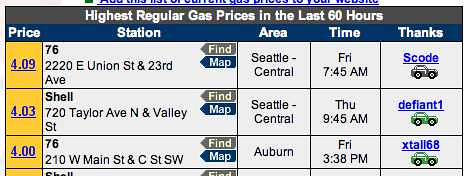
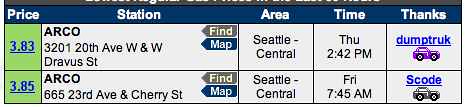
Anybody understand why Richlin’s has by far the MOST EXPENSIVE gas in the Seattle area (Regular is $4.09)? It’s not as though we’re all rolling in money and won’t notice the extra! BTW, given that gas is $3.85 at 23rd/Cherry, why does anybody stop at Richin’s?
(yes, yes, I know there’s a 45 cent debit card charge at 23/Cherry)
http://www.seattlegasprices.com/
Hope and resolution rise from blood and despair
Article in Thursday’s P-I about escalating violence and an Urban League plan to fight it:
http://seattlepi.nwsource.com/jamieson/376775_robert28xx.htm
You might care to add some sane “Soundoff” comments before the usual throng of anonymous P-I commenters chime in with their racist views.
Neighborhood Plan update
(Message below is from Chris Leman. He is chair of the City Neighborhood Council, [but writes here as a individual] and a seemingly full-time advocate for neighborhood issues. His grasp of the minutiae of City government is amazing. I was involved in the 1996-1998 Neighborhood Planning process, and found it very inclusive and engaging. I share his concerns about the Mayor’s proposals for updating neighborhood plans. I have highlighted some key features.
Andrew.
PS: this is brief, by Chris Leman standards.
PPS: many changes are underway in the CD, so we should be very interested in planning issues.
The files Chris mentions are available here)
Please be at City Hall 9 a.m. tomorrow–Thursday, July 31–and present a public comment as the City Council’s Planning, Land Use, and Neighborhoods Committee (PLUNC) considers the Mayor’s proposal to “update” neighborhood plans and station area plans. (And whether or not you can be there, please send in a comment right away!). Attached is the meeting agenda, and also three documents that the City Council received just todaythat contain the Mayor’s proposals. The City Council has stood up for neighborhoods by withholding funds with a “budget proviso” as it insisted on details on how the update process would work. But although those details are largely still absent from this latest proposal, the Council is under a lot of pressure to cave and provide the money anyway.
The Mayor is asking that the funds be released to “review the status of the City’s existing Neighborhood Plans as well as begin updating neighborhood plans in neighborhoods where transit stations have been or will be developed, beginning with those neighborhood plans that include station areas along Martin Luther King, Jr. Way South and on Beacon Hill.”
The station area plans (which were done with little public notice or involvement) would be updated without any assurance that the neighborhood plans where they are located would also be updated, if that is what neighborhood residents and business want (and if residents and businesses don’t want neighborhood plan updated, then it shouldn’t be). The City Neighborhood Council’s July 10 letter [available in the “What’s New” section at http://www.seattle.gov/neighborhoodcouncil/ ] still applies. The executive branch is proposing a top-down agency-run process that leaves no room for the grass-roots planning that worked so well in the 1990s. The Mayor is opposed to allowing neighborhood planning groups the funds again to hire consultants of their own; the City Council must insist that neighborhoods that want it should be allowed to repeat this successful and nationally heralded model. Also the proposed outreach to the general population in each neighborhood planning area and station area is very thin, with no mention of mailings, posters, etc., and with all meetings run by the Department of Neighborhoods, not by the neighborhood as was done in the past. In fact, after more than a year of discussion, these proposals have still not been sent out to the 38 neighborhood planning stewardship groups, which should be partners in this process! Instead, there is a lot of ideology about pushing light rail ridership and upzoning neighborhoods to reduce global warming. There is one piece of good news. Contrary to an earlier proposal to have the Mayor and City Council dictate membership on the proposed new Neighborhood Planning Advisory Committee, the attached resolution proposes that each of the thirteen district councils will select one representative, and they will have the majority, outnumbering the members selected by the Mayor, City Council, and Planning Commission. This change is responsive to the City Neighborhood Council and to the many of you who wrote in. Let’s get some further improvements in what the City Council will pass in the coming weeks!
Another topic tomorrow (see agenda) that the PLUNC committee will be discussing is the proposed “incentive zoning” under which developers would get upzoning and bigger profits if they guaranteed a certain amount of “affordable” units. They’re now calling it the “Affordable Housing Incentive Program,” probably to hide the fact that it involves zoning changes and bigger, bulkier buildings. The public comment period tomorrow (Thurs., July 31) starts promptly at 9 a.m. in the City Council chambers. Whether or not you can go, please write or call the councilmembers. Here are the address, e-mails and voice mails: Seattle City Council: P.O. Box 34025, Seattle, WA 98124-4025 [email protected] 684-8802 [email protected] 684-8806 [email protected] 684-8808 [email protected] 684-8807 [email protected] 684-8805 [email protected] 684-8801 [email protected] 684-8804 [email protected] 684-8803 [email protected] 684-8800
The above e-mail was prepared by Chris Leman, (206) 322-5463 as an individual, and is being sent out as a public service.
Danny Westneat column about 25th/Columbia murder
East Precinct Crime Prevention Coalition Meeting
EPCPC
East Precinct Crime Prevention Coalition
Thursday, July 24, 2008
6:30-8:00pm
@
Seattle Vocational Institute
2120 S. Jackson St
(free parking available in parking lot)
– – – – – – – – – – – – – – – – – – – – – – – –
Please find attached notes from the last meeting. Please feel free to contact me with any questions, concerns or feedback.
Thanks!
Sita DeGiulio Das
East Program Coordinator
Seattle Neighborhood Group
206.323.9666 (Main Line)
206.322.9330 (Direct Line)
[email protected]
http://www.sngi.org/
Redfin asks “How safe is 23rd & Union?”
A link on CHS: Seattle sent me to http://www.urbnlivn.com which somehow led me to:
“Redfin Real Estate Forums Seattle
http://forums.redfin.com/rf/board/message?board.id=Seattle&thread.id=2733
which I thought some of you might care to chime in on.
Monday: Court case about Design Review process
This is an individual message from Chris Leman (206) 322-5463, [email protected], and not offered on behalf of any organization.
Citizen observers are welcome and needed on Monday, July 7, 9 a.m. to 10 a.m. in King County Courthouse (516 Third Avenue) room E-733 as Superior Court Judge Julie Spector hears arguments by citizen activist Dennis Saxman and by lawyers for a developer and the City of Seattle in a case that Saxman has brought, arguing that Seattle’s design review and project approval process is not obeying the law.
Saxman alleges serious problems in Seattle’s Department of Planning and Development, the Hearing Examiner’s office, and the City Attorney’s office. He had appealed the DPD approval of a land use project on the 500 block of Pine Street between Belmont and Summit in Capitol Hill’s Pike-Pine neighborhood–ground zero for badly designed overdevelopment. When the Hearing Examiner sided with DPD, Saxman took the case to Superior Court.
It helps a citizen appellant for members of the public to be there in respectful attendance, and you are welcome to attend 9-10 a.m. Monday at the County Courthouse, room E-733. If you want further information, below is detail on the case, and how to donate if you are so inclined.
Why the case matters. Saxman has undertaken this effort because he believes that principles important to many Seattle neighborhoods are at stake, and that the project review system as it is currently practiced, is just plain unfair. Although no longer a practicing attorney, he benefits from his training and experience as an attorney in California, where he is still an inactive member of the Bar.
Many who closely follow the workings of Seattle’s design review process feel that the volunteer review boards, City staff, and Hearing Examiner do not always take the design guidelines seriously, thus favoring developers and undermining existing zoning. Bringing this dysfunctional system to the scrutiny of Superior Court poses the possibility of overturning it, or at least exposing such problems that the Mayor and City Council are forced into reforms.
Few have the energy and knowledge for an administrative appeal, and then the tenacity to take DPD and the Hearing Examiner to court. Dennis Saxman is that rare person who is seeing his case through, dramatizing the need for reform not only of DPD and the Office of the Hearing Examiner, but also of the City Attorney’s office, which seems to be over-zealous in defending the City’s position, acting in a number of instances to make citizen appeals particularly difficult.
Summary of the case. Saxman’s appeal to the Hearing Examiner argued that (1) the DPD Director was not justified in making a SEPA determination of nonsignificance; (2) in approving departures from the Land Use Code, the DPD Director had failed to show that development would better meet the intent of the neighborhood’s design guidelines; and (3) that the relevant design guidelines for the neighborhood had not been followed by the Design Review Board in making its decisions.
When the Hearing Examiner sided with DPD, Saxman filed a lengthy Land Use petition urging the Superior Court to find that the Hearing Examiner: (1) did not meaningfully consider and weigh all of the arguments and evidence; (2) did not weigh the credibility of DPD’s and the developer’s testimony and evidence; (3) treated Saxman and DPD differently when it came to the submission of evidence; (4) failed to adequately address appearance of fairness doctrine issues; (5) made errors of facts and law; (6) erred in finding the granting of departures was justified; and (7) erred in concluding that the project was consistent with the design guidelines.
Benefits of the case. Sixteen neighborhoods in Seattle have neighborhood-specific design guideline, and others are about to get them. Despite the guidelines, these neighborhoods continue to experience development that clashes with the neighborhood context—the very problem that neighborhood-specific design guidelines were supposed to solve. Saxman argues that, while neighborhood-specific design guidelines are meant to control design outcomes, the design review boards pay inadequate attention to the guidelines and DPD fails to ensure that they do, regarding the guidelines as not being binding.
Saxman’s case may establish a legal precedent that DPD and the Design Review Boards must follow the law and the design guidelines when evaluating projects; and more fully consider and heed public input. A clear victory would mean that the days of lax enforcement of neighborhood design guidelines by the DPD would be at an end and developers would be put on notice that they are required to abide by laws and guidelines proposed by the neighborhoods and enacted by City Council.
Here is Dennis Saxman’s summary of his goals: “In a nutshell, I think multiple design review, departure and SEPA analysis requirements are being ignored. If I prevail in this lawsuit, that should begin to change. I also think it would go a long ways towards beginning the repair of a review process that, as practiced, is highly biased against public appellants such as myself and that is not conducted according to the requirements of the law.”
Should Saxman lose his battle at the Superior Court level, the research he has done will still do a lot of good. He has found partiality and arbitrariness in the system–evidence that could help push the Mayor and City Council to reform the design review boards, DPD, the Hearing Examiner’s office, and the City Attorney’s office. If you have questions about the case or would like to receive documents about it, contact Dennis Saxman at (206) 328-5326 or [email protected]. As mentioned above, the hearing (case no. 08-2-05294-0 SEA) will be held 9 a.m. to 10 a.m. Monday, July 7 in King County Courthouse room E-733, Superior Court Judge Julie Spector’s courtroom. Citizen observers are welcome and needed.
Dennis Saxman has undertaken this case despite chronic poor health and very low income. It is not overdramatic to say that in expending vast amounts of energy and time, he is risking his life for a citizen voice and good design in Seattle’s neighborhoods. He needs donations to help afford the filing fees, exhibits, and the official transcript that, as appellant, he is required to provide. Checks can be made out to Dennis Saxman and addressed to him at 1717 Bellevue Avenue #205, Seattle, WA 98122.