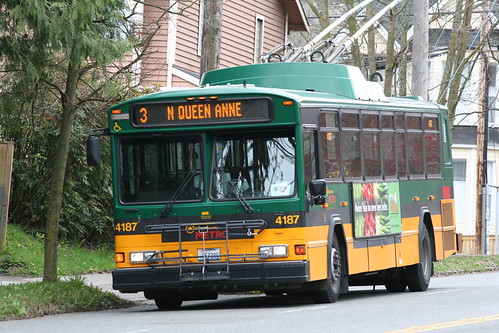
Based on our comments and conversations, it’s safe to say that the majority of people in the Central District would be sorry to see our trolley buses converted diesel. The livability aspects are important, such as how quiet they are. But there’s a common-sense efficiency aspect too: we’ve got cheap, environmentally friendly hydropower in Seattle. That must be better and cheaper than diesel, right?
We asked Metro for the raw data, and can say that yes, electric trolley buses have a big efficiency advantage over their diesel equivalents. Here’s how it shakes out:
- Trolley buses cost $0.35 per mile for electricity, or $1,021,854 for all of 2009
- Diesel buses cost $1.79 per mile for fuel. Based on current price of $2.30 per gallon, that would have cost $5,228,701 to run on the same routes as the existing trolley network
So based on raw energy prices, trolleys have a $4 million advantage over diesel buses per year.
But trolleys have a big additional cost that diesels don’t. The network of wires that power them requires constant maintenance, as they occasionally break or have to be moved for construction projects. Metro says that averages to $1.17 per mile of trolley service, or $3,400,367 for all of 2009.
That reduces the trolley cost savings to $806,480. Of course that money goes to a completely different place, into the pockets of local workers vs. paid to overseas oil producers. But it does significantly reduce the absolute cost savings of trolley buses.
The problem is that the core of the county’s possible decision to abandon the trolleys is driven not by operational costs, but by capital costs. The existing bus fleet will be worn out in 2015, and new trolley buses are much more expensive than diesel hybrids. The Seattle Times reported that it’s at least $280,000 more expensive per bus. That adds up to $44 million to replace all 159 trolley buses.
So in many ways this comes down to a very simple financial equation. Is the capital cost for new trolley equipment worth the projected operational cost savings over the life of the buses?
The answer is maybe, and depends on how much we expect the price of oil to increase over the next 20 years.
We broke out our long-neglected Engineering Economy textbook to calculate the time-value of money:
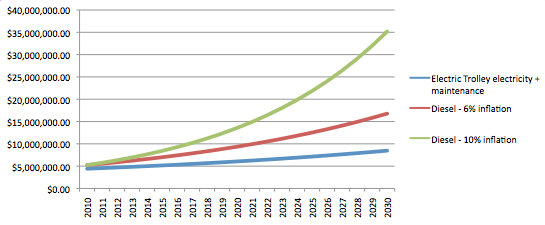
- If we assume that fuel prices will grow at 6% a year (to $7.37 a gallon in 2030), the operational cost savings are only worth $27 million, which is not enough to close the gap for the increased capital cost
- However, if we assume that fuel inflation will be 10% a year (to $15.47 a gallon in 2030), the operational cost savings are worth $74 million, which is easily enough to justify the purchase price of new trolley buses
- A fuel-inflation rate of 7.75% ($10.23 a gallon in 2030) would equalize operational savings and capital costs.
So if gas prices go up at the rate we saw a few years ago, it’s a no-brainer to invest more to keep the trolley bus network.
Stay tuned as we look at other aspects of the trolley bus decision over coming weeks.