The People of the Central Area: Bob Santos, Leader & Activist, Former Director Inter-Im CDA

This post is part of a series of profiles of Central District residents, part of the “People of the Central Area” project developed and written by Madeline Crowley.
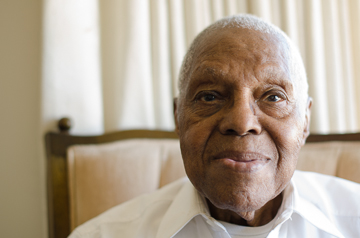
Bob Santos, photo by Madeline Crowley

About Bob Santos:

He sparkles with energy, charisma and depth – that very energy allowed him to accomplish real change in Seattle. Growing up in the Central Area of the 1940s with its multi-ethnic communities laid the foundation for him to become an enormously effective community leader.

Bob on the Central Area:

I was born in 1934 in Seattle’s International District (the ID). My Dad was professional prizefighter and my parents lived in the ID in the early 1930s. Then, my mother passed away in 1935. My Dad couldn’t take care of my older brother and I. He was a widower and his fighting career caused him to slowly lose his eyesight due to boxing injuries. Eventually an aunt, my father’s sister, took us in. They lived in the Central Area on 14th & Spruce and later 14th & Columbia.

When my father completely lost his eyesight in 1945, I became his Seeing Eye dog, so I would come down from the Central Area to the NP Hotel in the ID to take care of him. I lived in the Central Area and went to school there. I was running back and forth between the two neighborhoods so I could take care of Dad.

In between, I hung out with kids in the Central Area, mostly at the playground at the old Maryknoll School. That was a missionary school; the sisters came in the 1920s on a mission to convert Asian Americans, Japanese nationals and Japanese-Americans to the Catholic faith. They established the church and school between 16th & 17th Avenues. 90% of us were Japanese and the rest were kids from the neighborhood. I attended Maryknoll Elementary for kindergarten and first grade.

I was in first grade in 1942, when our neighbor kids, the Japanese kids were rounded up and taken to concentration camps first to Puyallup and then Idaho. After that the school then became much more like a community center. The church still operated during the war but the school closed. The Filipino community grew around that church. Initially, it was Japanese and then it became Filipino during the war years.

There were a couple of German families in the church too, the Doedenhoff family and the Schmidt family. We always asked those kids, ‘How come you aren’t in jail? We’re at war with Hitler.’ And no one could give us a reason.

There was no reason except we were different, the Japanese, Chinese and the Filipino. We learned about that difference during the war when our Japanese friends were taken to concentration camps. The Filipino and Chinese kids were always picked on by the white kids, or the black kids, or the Jewish kids. When I lived at 14th & Spruce sometimes I had to get two blocks north to the Immaculate Church School. There were blocks I couldn’t walk down because of these two kids; they were black kids. I still remember who they are. They’re still alive today. Back then, if I passed down their block, they’d beat me up. At that time, all Asians were lumped in with the Japanese, it didn’t matter if you were Filipino or Chinese. It made no difference to them; you were the enemy.

Because we got beat up by the black kids and the other kids then the Filipino kids and the Chinese kids started to stick together, to watch each other’s back. That made it a little safer. But even when we rode the trolleys to go downtown people on the trolleys would yell at the driver, ‘Kick those Japs off the bus!’ So we started wearing these tags that read, ‘I am Filipino’ or ‘I am Chinese.’

What was your happiest memory of the Central Area?

At Maryknoll Kindergarten, I fell in love with a girl named Pauline. In first grade I’d go around with my Dad to the gambling halls down in the ID. Since my Dad had been a boxer, he was a hero not only to the Asian community but also in the Seattle sports scene. After he retired from boxing, he’d go to all his favorite places: the restaurants, the barbershops, the gambling halls, the haberdashery shops, and he’d bring me along. At the gambling halls, if these guys were winning I’d get a nickel, a dime or a quarter. We’d go from spot to spot. If my Dad forgot a place, I’d tell him we had to go there. I got all this change together.

In the first grade, Pauline was sitting up by the teacher. We had wooden desks with two people facing each other so I paid my way up to sit next to Pauline. I remember I had to pay a couple of folks off to sit next to Pauline. That was the happiest day of my life. Of course, one day we went to school and Pauline and all the other Japanese kids had been hauled off to concentration camps. And only the Filipino kids were left. That was the saddest day of my life.

To read the rest of the story, click here.

Blotter | Seattle U street robberies, Close shave on S Main

See something others should know about? Email the tips line.

  • Rash of Seattle U street robberies: Seattle University is warning students about a rash of crime in the past few days around the campus on the southern edge of Capitol Hill. In the most serious incident, two suspects beat their victim and stole his car near 13th and Jefferson early Monday morning. According to the report on the incident, the two assailants stole a gold Honda Civic in the 1:25 AM attack. The suspects were described as two dark skinned males in their 20s, both around 6-foot tall and both had what the victim believed to be East African accents. Seattle Fire Department medics were called to the scene to treat the victim who was bleeding from the mouth.Later that day around 5:25 PM, a SU student waiting near 11th and E Marion was approached by two men who asked her if she had cigarettes. “After the student gave the unknown men cigarettes, one of them put their arms around her, reached into her jacket pocket, and unknowingly stole her Iphone,” the report states. The men then left on 11th Ave. through campus as the victim realized her phone was missing and sought help. Both suspects ”appeared to be East African in their early 20’s. One was wearing a dark colored light weight hooded jacket with dark jeans, approximately 5’ 8” tall. The other was wearing a light weight black jacket, dark jeans, cornrow braids, and approximately 5’ 10”,” according to the report.Meanwhile, late Saturday night “two SU community members” were robbed as they waited for a taxi in the area of 21st and E Jefferson:

    A person described as being a dark complexion male, in his early twenties (21-25) of average build and height, wearing a black hoodie approached them and grabbed onto the victims clutch wallet. The wallet strap was around the victim’s wrist so she was pulled to the ground and dragged several feet before the suspect freed it from her and fled the area. SPD responded to the location for a report, and the victim was treated for minor injuries by SFD. No weapons were seen or mentioned during the incident.

  • Close shave on S Main: The report on this 12th/Jeff hair cut gone very, very badly is pretty much one of a kind:

    Screen Shot 2013-12-10 at 10.40.18 AM Screen Shot 2013-12-10 at 10.40.26 AM

Washington Community Action Network set to move into MK Fish Building

We reported last month that the MK Fish Building at 18th and Yesler, the current home of the Samarya Center’s yoga school, sold to a new owner.

That new owner is the Washington Community Action Network (CAN). The grassroots advocacy organization plans to use it as office space, relocating their current offices from Georgetown to the Central District.

Rachael DeCruz, Communications Director at Washington CAN cited several reasons for the move, the most significant of which is tied to the organization’s very mission.

“We’re advocating for racial, social, and economic justice,” DeCruz says. “A big piece of our work is organizing with low income communities and communities of color, and insuring that the people most impacted by the issues we’re fighitng for are front and center in the fight. We’re excited about the opportunity to move back to the community. It will feel like we’re coming home.”

DeCruz noted that the Georgetown location is also sometimes hard to find and isn’t centrally located.

Washington CAN plans to renovate the space and be settled around mid-March.

Meanwhile, the Samarya Center is still raising money for the purchase of a new space at 17th and Jackson for their yoga classes. Their online campaign has raised nearly $24,000 of the $50,000 goal so far.


Affordable Care Act Health Insurance Sign Up Day – Swedish Cherry Hill Dec 12th

CA-13-1131-O-ACA-Health-Insurance-sign-up-flyer-finalSwedish Medical Center – Cherry Hill Campus will be holding a free public session to help those who are signing up for new healthcare insurance through the Washington Health Benefit Exchange. It’s scheduled for Thursday, December 12 from noon to 8 p.m. in the Casey Room at Swedish Medical Center Cherry Hill Campus 500 17th Ave Seattle WA 98122.  If you are not able to attend, please call 206-386-6996 to set up an appointment.
17th and Yesler to get four-story live-work building

1622 E. Yesler Way

1622 E. Yesler Way

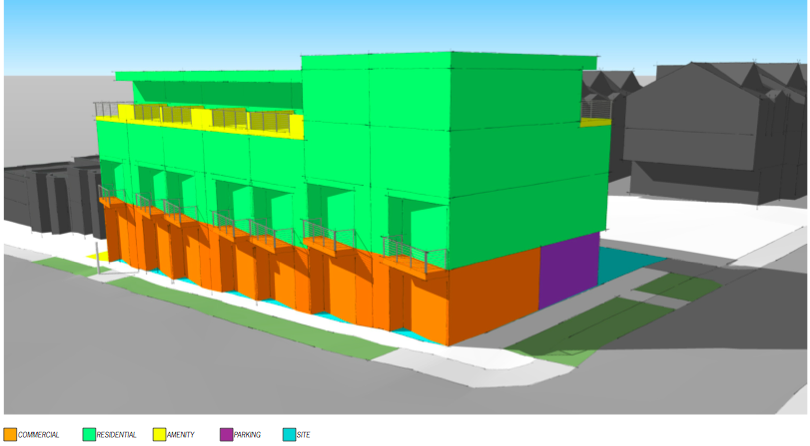
The dilapidated former gas station and auto repair shop sitting at 17th and Yesler will soon be replaced by seven four-story “live-work” units.

That means there will be 3,200 square feet of commercial space on the ground floor, facing East Yesler Way. Each residential unit will have its own enclosed parking space, located behind the retail area.

The project is still in its design review phase, so we don’t have pictures of the architecture just yet. Those details are the responsibility of Caron Architecture, the same architects who designed the building at 23rd and Madison that houses Safeway. Caron has not responded to emails requesting more information.


Lake Washington Girls Middle School Robotics Team to Participate in Sunday’s FIRST Lego League (FLL) Robotics Challenge

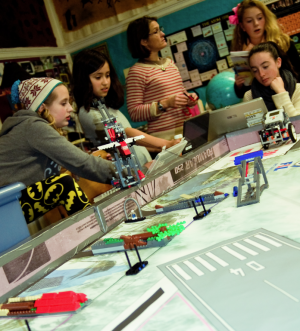
Screen-Shot-2013-12-07-at-4.57.46-PMThis term Lake Washington Girls Middle School has been offering a robotics and programming club – FuerzaBots! Guided by science teacher Kirsten Rooks, technology director Cristina Paredes, and parent Rob McCann P’14, the FuerzaBots team has been busy preparing for the FIRST (For the Inspiration and Recognition of Science and Technology) Lego League (FLL) Robotics Challenge. Each year, FIRST releases a new challenge that engages teams in hands-on robotics design and scientific research. The theme for the challenge is different each year, allowing teams to learn about a variety of subjects. This year, teams will apply research and robotics to explore natural disasters with FLL “Nature’s Fury” challenge. To successfully complete the challenge, teams of young people must build and program a Lego Mindstorms robot to complete missions on a thematic playing surface and conduct research to discover what can be done when intense natural events meet the places people live, work, and play. This is Lake Washington Girls Middle School’s first year participating in the event.

The FuerzaBots, comprising sixth grade students Eva, Ula, Julia, Maya, and Lucy, seventh grade students Paisley, Hava, Jayla, and Mackenzie, and eighth grade students Rae, Alma, Sadie, Helen, Josephine, and Savita, have been tackling this year’s Challenge as a unit. Each Challenge has three parts: the Robot Game, the Project, and the FLL Core Values. Teams of up to ten kids (on the competition floor), with one adult coach, participate in the Challenge by programming an autonomous robot to score points on a themed playing field (Robot Game) and developing a solution to a problem they have identified (Project), all guided by FLL’s Core Values – that friendly competition and mutual gain are not separate goals, and that helping one another is the foundation of teamwork.

The theme for this year’s competition is Disaster Relief: Nature’s Fury. For the “project” part of the challenge, teams were tasked to develop an innovative solution to help people prepare, stay safe, or rebuild after a natural disaster. The FuerzaBots – using the process of Design Thinking – created an app that will help people find and gather an emergency supply kit closest to them (utilizing geo-location), instruct the user how to operate the kit’s contents, and offer information on how to best handle the emergency situation at hand – in their case, a volcanic eruption. The FuerzaBots are preparing a presentation of their app to share with the judges at this weekend’s tournament.

The FuerzaBots have also been working diligently on the Robot Challenge for which, over three months, they designed, built, and programmed four robots, one of which will tackle as many obstacles of natural disaster aftermath as possible in 2.5 minutes. The FuerzaBots dove into programming the “brick” – the brains – of the robot, and they quickly learned how the sensors work and in what situations they would be used. They also mastered how the motors work to make the robot go forward, backward, and to turn, as well as how to make the robots pick items up and move levers. As of today the FuerzaBot’s robots can complete six of the ten course obstacles.

The FIRST Lego League (FLL) Robotics Regional Tournament is this Sunday, December 8, at Ballard High School. During the tournament, teams have three rounds on the competition tables to get the best score possible. When not competing with their robots, teams give their research presentations, and are interviewed about the technical design of their robots and how they work as teams. Regional qualifiers may advance to the championship event in January. The winners of the Champion’s Award, the most prestigious award, may be eligible to participate in a variety of post-season tournament opportunities both domestic and abroad. Our FuerzaBots, whose motto is “Code Like a Girl,” are excited to be participating in the tournament for the first time and will be focusing on getting as far as they can and learning from the mistakes they make along the way.

Go, FuerzaBots!

Lake Washington Girls Middle School, located in Central Seattle, is a place where girls explore, experiment, discover, create, and learn about themselves and the world around them. Since 1998, LWGMS has challenged its students with high standards and helped every LWGMS girl find the tools she needs to succeed. Here, girls are empowered to think critically, develop leadership, and enjoy learning through an integrated curriculum that has proven to prepare girls for success in high school honors and college preparation courses.

Our cooperative, experiential, holistic education supports girls throughout their middle school years – academically, socially, and emotionally. We have small classes, caring teachers who work with students as they move from sixth through eighth grade, and strong parent and community involvement.

Indie Book Fair: Modest Means, Serious Writers

Indie Book Fair

Modest means. Serious writers.
December 20 & 21, 2013 — 11AM – 8PM

A/NT Galley
2045 Westlake Avenue
Seattle, WA 98121

Looking for a last minute gift?

Books.

Lots and lots of books.

There will be books for all ages. Science fiction, fantasy, romance, young adult, mystery, memoir, and so much more.

Meet the authors, too. They’ll be there, selling their books. You can get them to sign the books. Grab their swag, like bookmarks, postcards, and such. Many of them will have raffles for even more free stuff!

Authors in attendance include: Ksenia Anske, Leeland Artra, S.C. Barrus, Laurie Blauner, Zachary Bonelli, Kate Bracy, Jamie Brazil, Paddy Eger, J. Glenn Evans, T.M. Franklin, Jerry Gold, Elizabeth Guizzetti, David D. Horowitz, Paty Jager, Sibyl James, A. Ka, Kay Kinghammer, Susan Lute, Maggie Lynch (Maggie Jaimeson, Maggie Faire), Michele Makinson, Mark Matteson, John B McIntyre, Robert R. Mitchell, Old Nod, Northwest Independent Writers Association, Chris Patchell, D.E.S. Richard, Laura Kelly Robb, Susan Schreyer, Valerie Stein, Lisa Stowe, Jeff Suwak, Griffith H. Williams, Windtree Press, Joyce Yarrow, and Matt Youngmark

On Saturday, December 21, the authors will read excerpts from their books, from 5:00PM to 8:00PM. Refreshments will be served. A touch of wine, too, for those over 21.

And Art!

Lots and Lots of Art.

Since it’s in a gallery, there’s art everywhere. All around, you’ll have plenty of time to absorb some culture and buy some unique gifts for the holidays.

Candy Cane Hunt/ Ugly Christmas Sweater Contest

cartoon-running-candy-cane-27701334Join us on December 8th
Burien St. Vincent De Paul Thrift Store
13445 1st Avenue S, Burien, WA 98168

11:00 AM – Candy Cane Hunt
12:00 PM – Ugly Christmas Sweater Contest
12:30 PM – Best Christmas Hat Contest
1:00 PM – Giant Wreath Drawing
Prizes and Refreshments

Kids of all ages are welcome .

This is a free event

Catching up with local band Stereo Sons

Stereo Sons (photo courtesy of the band)

Self-described as an “indie rock power trio” with “monster riffs, pop vocal hooks, deep grooves, and an explosive live show,” the Seattle band Stereo Sons recently recorded its upcoming album at Push/Pull Studio in the Central District.

I caught up with band member Chris Klepac to talk about the new album and life in the Central District.

CD News: Tell me about your new album. When is it coming out and what can listeners expect?

Stereo Sons: We’re All Friends Here is the second Stereo Sons album, and it will be released online on Jan. 7th 2014. It’s very different from the first album, Our Own Devices. That record was recorded and mixed in three days. We were a very different band, we had a different bass player (Marty Lund) and we were sort of hard-rock oriented, with a lot of very stripped-down arrangements of electric guitar, bass and drums. By contrast, We’re All Friends Here was recorded over a much longer time span. It’s the first full set of songs we’ve written with our new bass player, Carlos Tulloss, and he’s had a lot of influence on our style. In fact, I can’t really just call him our bass player. He plays bass, and keyboards, and samples, while Mike O’Doherty (the drummer) also has a sampler, and I play both guitar and keyboards. We’ve become less of a straightforward rock band  and more a band that makes songs out of a lot of layers of different sounds and styles, from dirty 1970s prog-synth sounds to things you might hear on a more “modern” record like electronic beats and loops. But while we’re changing in this way, there’s still this impulse to keep the level of intensity right where it was when we were rocking out at the beginning of the band. So I think this record is partly about that process, how do we become this entirely new thing while still maintaining that energy and focus.

Content-wise, I always sort of think of every album as a concept album. The idea for this one came out of an experience I had going to a wedding about two years ago and seeing a bunch of childhood friends. It brought up a whole bunch of ideas and emotions about how relationships change over time and what friendship really means when you’re an adult, and how we deal with all these changes. Some of it is kind of dark but overall I think it’s hopeful.

photo courtesy of Stereo Sons

CDN: You recorded it in the Central District?

SS: Yeah, at Frank Mazzeo’s Push/Pull studios, which has recently moved, but when we were there it was based out of an artist space called the Hiawatha Lofts, his studio overlooked that Shell station on Rainier next to the weed dispensary that used to be Stan’s Fish and Chips. We actually recorded all the drums in this big open area with a piano on the ground floor of the Hiawatha building, which is mainly used for community events (I’ll send some pictures). Frank ran cables down the stairwell from the fourth floor where his mixing gear was, and was talking to us on headphones, and constantly running downstairs to adjust microphones. It was kind of an awesome nightmare technically, but he got some really great sounds out of that space.

When we were doing overdubs there we’d always run down the hill to this Peruvian place called  San Fernando Roasted Chicken, and I still go there a bunch, I think we all got addicted to the green sauce.

CDN: What aspect of the new album are you most proud of?

SS: Well the obvious answer to me is just the raw sonic quality, the audio production values. Frank worked with us on these songs for a long time, and he really knocked it out of the park. We’ve all talked about how this is the best-sounding thing any of us have ever made.

Less obviously I can say the songwriting means a lot to me. Writing songs in a band means making a collaborative art project, and the quality of the finished product is totally dependent on how well the band works together. Everyone takes a turn steering the boat, everyone fights for their ideas sometimes, everyone compromises sometimes too. I think the best bands have members who can work together well, but also have slightly varied tastes and strong opinions about those tastes, so there’s always this friction that keeps everyone pushing each other a little bit. When you respect the musicians you work with, you want to bring your A-game all the time, and I think we did that here.

CDN: What about life in Seattle or the CD has influenced your music?

SS: The CD is a great microcosm to walk around in and understand the city. I was talking about the Hiawatha, that’s this really modern-looking artist loft complex, overlooking Rainier Ave, which hasn’t changed much in twenty years. Up the hill behind Hiawatha you have both old family homes from the 50s and modernist cube houses that are less than five years old, plus institutions like the Franz bakery. The CD is like Seattle in that it’s a patchwork quilt of different eras of development, and it all has to do with where money is flowing at any particular time.

Our music isn’t really political in the traditional punk sense, but a lot of our songs are about how big systems interact with ordinary people’s lives, and how that can be randomly positive and terrible. There’s a song on Our Own Devices called “One Block” that was written specifically about Ballard but could apply to Seattle in general. It tells the story of a group of millionaires who are charmed by the neighborhood so much that they decide to move in, knocking down all those musty old brick buildings in order to put up anonymous condo towers. We saw the same thing in Capitol Hill a few years ago, when developers were so enraptured by the Pike/Pine corridor that they obliterated it.

Of course, that reaction provokes the opposite reaction: should everything just be kept in a bubble and not get the economic benefits of new development? And obviously that’s not right either. So you have this patchwork of compromises in which some good things happen to a neighborhood but some of the essential character is lost, and maybe that’s just the same story as the corporatization and blandification of America and the world in general.

As for Seattle’s influence, I should note that the house on 16th Street where Stereo Sons first practiced is the house that I still live in, and has supposedly been a notorious musician hangout for decades. There’s a Spin magazine photo somewhere that features our old practice space, many years before we moved in. Anyone in a band here who rents space or plays shows or hangs flyers is constantly brushing up against grunge-era ghosts in all kinds of ways. It’s a mixed thing, you’re inspired by that legacy and you want to make something as real and direct and visceral as the music that made Seattle famous, but at the same time that’s a vanished age, and surviving as a band is a very different proposition now.

photo courtesy of Stereo Sons

CDN: Any favorite CD hangouts or businesses?

SS: I’m not far from a few landmarks that are pretty influential on me. A few blocks away you have Washington Hall, which is a fantastic building that was a Danish social hall and an important venue for the classic jazz scene that happened here, also near there is Langston Hughes Performing Arts Center, this huge old stately dome from the era of real solid civic investment in the arts.

I also admitted I’m fascinated by “Pill Hill”, from the old brick chimney of Cherry Hill Swedish to the kind of seedy sprawling mass of Harborview, it’s this whole culture and environment that I’m kind of immersed in daily when I pass through on the bus, there are a thousand stories I catch little glimpses of, people passing through this massive multi-hospital system. Again it’s this constant interplay between giant impersonal systems and real people, sometimes it works and sometimes not so much.

As for hangouts: I’m sad to admit I still haven’t found a neighborhood bar to call my own. I usually end up on 12th to quench my thirst, but really you’re most of the way to Capitol Hill by the time you get there, so why not just keep walking? We need a pub up between 16th and 20th. .I can’t complain too much though, because I’m only a stone’s throw from both Ezell’s (best fried chicken in town) and The Barbeque Pit on Cherry (best ribs in town) so I should count my blessings. Broadcast Coffee across from the park is another reliable weekend destination, and I’ve heard good things about both Moonlight Cafe and Cheeky Cafe. There’s lots to explore in the CD!

Listen to the title track off the new album:

The People of the Central Area: Fordie Ross, Former Moderator, Madrona Presbyterian Church

This post is part of a series of profiles of Central District residents, part of the “People of the Central Area” project developed and written by Madeline Crowley.

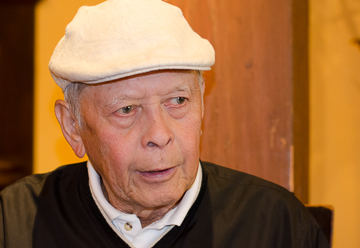
Photo by Madeline Crowley

Photo by Madeline Crowley

About Fordie Ross:
Even at nearly 100 years old, Fordie’s life revolves around service to others. It gets him up and out to Y’s Men’s meetings, to church and out on his 2-mile walks. He is a living example of how a life focused on giving keeps you alert, active and fully alive.

Where did you and Thelma live in the Central Area?

On 32nd Avenue, north of the Madrona Presbyterian Church. In the early 1950s, we lived in a house that had a dirt basement. Every week I would go and get concrete. I finished that floor. I have to ask what you have heard of me?

You’re spoken of very fondly as a very smart, very kind man. Mr. Zimmerly told me you’re a good man with a long history with the church. I also saw an article on your walking program in the Seattle Times.

I have a long history of service both in Seattle and the Church. Also, I do walk every day. One day a reporter from the Seattle Times asked to walk the two miles with me. When we arrived back home, he said, ‘Hey, let me get inside because I have to sit down.’ He was tired.

Can you begin with the Grace Church?

The Grace Church (formerly on Cherry & 22nd, building still extant) would be about the same size as the living room of my house. Before that though, my wife and daughter were born in Oklahoma City, OK.  I lived there and worked at a Baptist Church. One day, I met a Seattle Minister who found out I was well versed in Sales. He told me about a newspaper in Seattle. Then, the owner of the paper called and asked me to come to Seattle to take a test to become the Editor of the paper. His name was Noodles Smith, the richest black man ever to come to Seattle.

I came to Seattle, as did five other black men from around the country. We were all given a test, which I won. Two weeks after I moved here, Noodles Smith dropped dead. I didn’t have the money to keep the newspaper going and his family couldn’t agree on what to do, so the newspaper was closed. That meant that I was out of a job. (long pause) I pause because if I tell you what happened immediately, I would kill the magnificence of the whole story. I won’t tell you right at this minute.So, let me tell you that my wife, child and I had come to Seattle and we arrived on a Sunday. On that same Sunday we found Grace Presbyterian Church. I was born a Presbyterian, my father was a Presbyterian Minister. We not only joined the Church, we pledged and we never missed a pledge from 1952 until today.

To read the rest of the story, click here.