
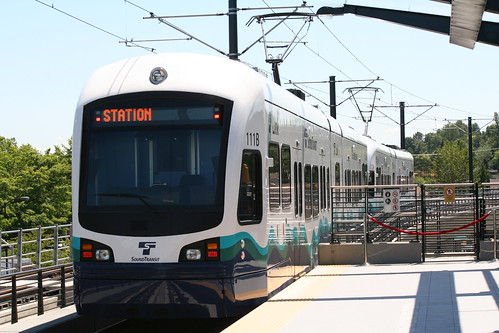
Here in the Central District we’re very heavy users of transit. Our bus routes are standing-room-only for much of the day. And we’re also naturally big supporters of transit, giving super-majority votes to recent initiatives to expand light rail and increase bus funding. But with light rail running on I-90 and the streetcar on Broadway, so far we’ve only been skirted by the improvements. We’ve been left out of any planning that would bring the capacity, speed, and reliability of rail transit to the core of the neighborhood.
Back in November we asked our new Mayor to focus on a citywide plan for transit expansion that would include the Central District. With all the talk of adding rail service to West Seattle and Ballard, it was alarming that there still wasn’t any long-range plan to connect our neighborhood and other parts of the city to the growing regional light rail system. The obvious risk is that at some point our local support for transit could start to wane if our taxes only go up while others get the goodies.
We’re happy to report that the mayor’s office responded to one of our earlier queries, and announced that the city is beginning a new Transit Master Plan that would provide a long-range vision for the expansion of transit around the city, including here in the CD. Here’s part of the email from Nathaniel Merrill in the mayor’s office:
The mayor shares your view that Seattle needs to update its transportation planning to include a more robust transit element. The new Transit Master Plan, which we expect to begin developing within the next few months, is envisioned to serve as a blueprint for transit investments in the same way that the recently adopted Bicycle and Pedestrian Master Plans are guiding the development of improvement to help make biking and walking easier in Seattle. With a Transit Master Plan in place, the City will be able to pursue funding to make key transit investments in neighborhoods like the Central District and throughout our city.
We followed up with the city Department of Transportation to find out more, and SDOT spokesperson Rick Sheridan told us that while it’s too early in the process to get many specifics, the broad goals of the plan will be to:
- Develop transit service and capital investment priorities and recommendations
- Make commitments to provide minimum levels of speed and reliability for high-ridership transit routes
- Identify minimum service frequencies and span of service for high-ridership routes
- Generate more transit funding to support growth in Seattle and the region
- Improve coordination with Metro and Sound Transit planning activities
- Include a plan for reducing greenhouse gas emissions from transit vehicles
If done correctly, the plan should give us a prioritized list of potential transit investments based on real data such as cost, ridership, and time savings. Ideally, that would help take politics and geographic biases out of the equation and help route funding to areas where it’s most needed.
Sheridan says that work will begin this year with a goal of finishing the plan by the end of 2011. We’ll be following this closely and will keep you up to date as it develops.
Seems like 23rd is a natural candidate for some sort of light rail or streetcar..I realize the problems of the incline/decline near the north end but perhaps a semi-elevated causeway could alleviate some the problems a train would face. 23rd is is where our community should focus its energies on as it is really the “life” of the Central District. Tossing rapid mass transit on it–at least from aloha to Mt. Baker Light rail station–is criticial.
23rd would be a good choice but given traffic and grade it seems like a mess. running a street car from the Mount Baker light rail up MLK to Madison and then on thru to meet up at the UW station. this would offer little or no grade to deal with and promote improved density for miles along MLK where as 23rd already has lot of density. basically kill the Metro 8, yes I am aware the 8 goes to Seattle Center.
Its been about a year since I’ve relied extensively on mass transit and so I don’t know the direct effect of the altered 8 and 48 schedules on ridership. When I was riding regularly, the 48 was always more crowded through the CD (southbound) while the 8 would empty considerably by the time you passed the Safeway on John. There never was as much demand for stops on MLK as there was on 23rd (although the comparison between a bus going from the U and one from the Seattle Center is a poor means of comparison).
23rd is also considerably more commercialized than MLK, and street car placement seems to pretty heavily favor areas that are reasonably commercialized now.
That said, I’m pretty skeptical about the benefits of street cars over buses.
“I’m pretty skeptical about the benefits of street cars over buses”
– I’m not. I won’t ride a bus, but I will ride a street car.
That’s the benefit.
Why would you not ride a bus and on the other hand ride a streetcar?
“because i am a jackass with a silver spoon”
From personal experience with the SLUT, the only advantages over a bus that the streetcar has is that it lacks fare enforcement and is generally cleaner. The former needs to be dealt with if the city seriously wants to increase the number of lines in the city, and the latter is more a factor of the people who generally ride and the fact that the SLUT doesn’t go anywhere
Additional issues with streetcars include their impact on traffic over buses (Fairview by the FHCRC is painfully backed up around 5-5:30 around half the evenings because of the idiotic priority system the SLUT has at intersections, and even manages to delay itself). The tracks are also a hazard to cyclists.
The Fairview and Mercer backups have nothing to do with the signal priority at the light, it’s the thousands of single-occupant vehicles getting onto I-5. Too many cars, too little space. I work right by there and see it every evening–it’s literally 8-9 SOVs for every carpool or truck.
No idea about him, but the SLU Streetcar has several benefits over existing bus routes:
low floors for easier boarding especially for wheelchairs and strollers
the option off-board payment (hopefully ONLY off-board payment soon)
more seating than some Metro buses
larger stop spacing than some Metro routes (roughly equivalent to the ones with stop revisions)
clear tourist-friendly routing and marketing
comes every 15 mins, more frequent operation than many routes (especially during the day)
It’s up to you whether you think these offer enough benefit, and in theory they could all be implemented on existing bus routes (Vancouver BC for example has low-floor buses), but no one is proposing that to my knowledge. I’d happily support it if they did.
more study by SDOT
Here’s the LAST transit plan from way back in 2005
http://www.seattle.gov/transportation/transitnetwork.htm
there is the minor detail of the $15-30M per mile investment. but hey, its only money.
Many metro buses have entrance floors that lower. They are adjustable. I have not noted more seating than most buses. Most of the well-used bus routes are every 15 minutes during the day.
This region’s taxpayer-funded transportation planning agency, Puget Sound Regional Council (PSRC), has published its Transportation 2040 (T-2040) Plan for inspection by public officials and other citizens in the run up to its scheduled approval vote by the PSRC General Assembly on May 20.
Inspection of the transit sections of this PSRC T-2040 plan, shows that at least some the work of City of Seattle on the Urban Village Transit Network in the Greg Nickels’ administration has been incorporated. Four UVTN routes are listed for accomplishment by 2020, namely, Metro Routes 5, 7, 44, and 48. Other UVTN routes are included in the financially unconstrained portion of the plan, which means the funding source is unclear.
I posted selected pages from the T-2040 Plan on transit at http://www.bettertransport.info/pitf/PSRCtransitPlan2040.pdf .
Anything new or changed that the McGinn Administration comes up with can be incorporated into T-2040 updates as developed. Although officials from the whole region votes on updates, the wishes of individual jurisdictions are invariably approved as long as regional considerations are taken into account.
Overall, T-2040 incorporates a large ramp up in local bus service and associated bus-priority road improvements throughout the region to the point where bus boardings are forecast to exceed rail boardings in 2040 by a ratio of 4 to 1, even in the financially constrained portion of the plan, this being the part of the plan where the money to pay for it comes from a known and likely source.
One zinger: The PSRC forecasts for regional rail boardings in 2040 (164K daily) don’t even come close to reaching what the Prop 1 tax increase plan for ST2 approved in 2008 claimed would be achieved by 2030 (312K daily which I compute from 95 million annually in ST2). Again, bus boardings in 2040 outnumber rail boardings by 4 to 1, so City of Seattle’s ongoing work on bus transit planning is critically important.
As you might imagine, every word of T-2040 has been published on the Internet. Go to http://www.psrc.org/transportation/t2040 for access to the document stash incorporating multiple megabytes. The most detailed description of the transit projects included is in Appendix A of the FEIS at http://www.psrc.org/assets/3694/Appendix_A_-_Transportation_ , the full document that I excerpted from as noted above.
The performance of all transportation spending that is planned by 2040 is detailed in Appendix D of the FEIS at http://www.psrc.org/assets/3698/Appendix_D_-_Policy_Analysis .
It’s been 9 years since the last PSRC 30 year plan was issued, called Destination 2030. This new T-2040 will probably be significantly revised about 2020.
Of note, Seattle Mayor McGinn was one of two regional officials who voted against approval of T-2040 on March 25 at the Executive Board meeting of PSRC. Seattle City Council members voted in favor of T-2040.
The Monorail “Green Line” featured prominently in the last transit plan.
I think it needs a slight update.