Ethan Stowell’s Red Cow is open for business in Madrona

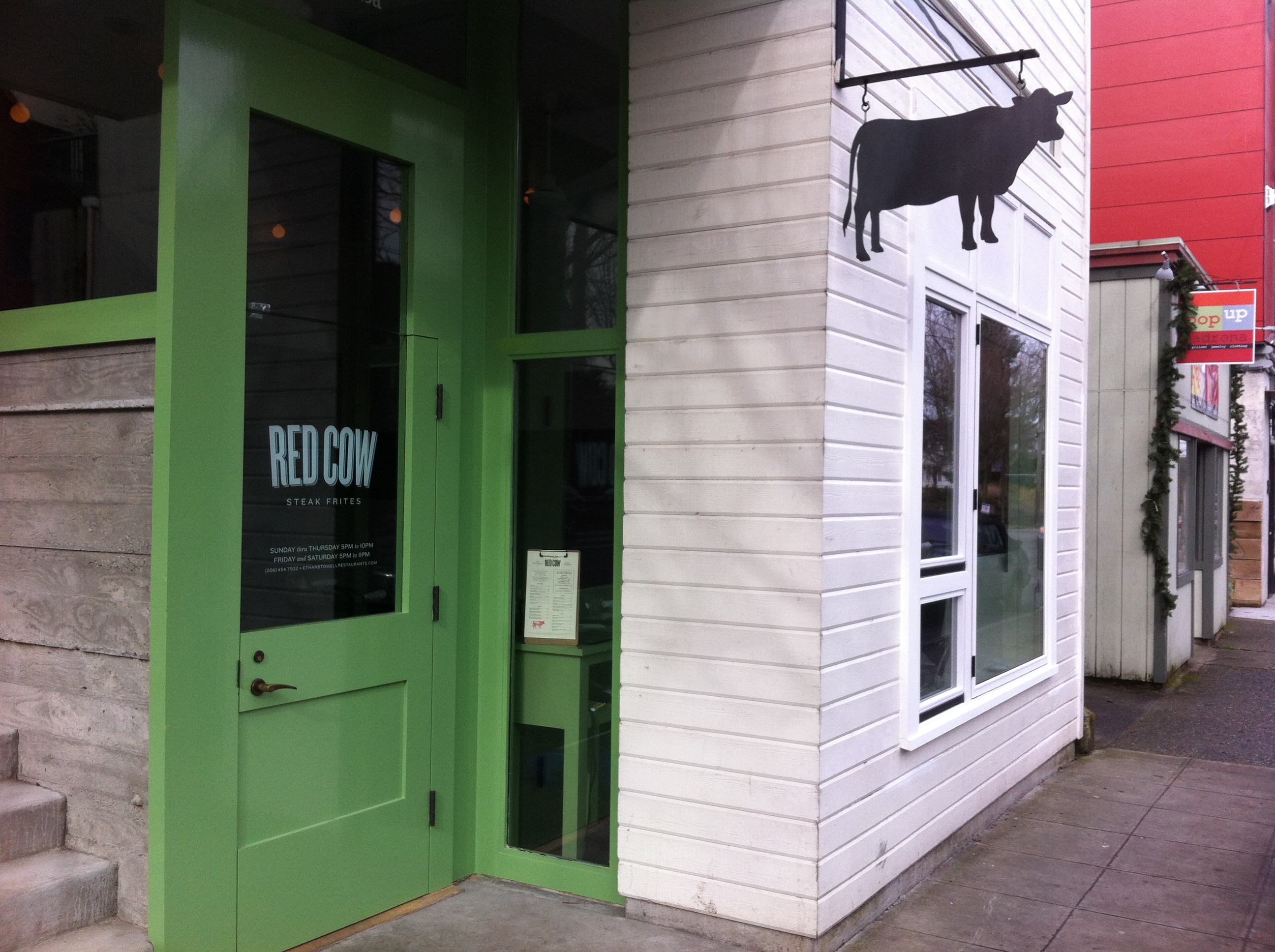
photoThe latest installment of Ethan Stowell’s apparent attempt to take over Seattle is Red Cow, a brasserie in Madrona. Red Cow opened last night with a packed house; diners filled nearly every spot in the 1,800-square-foot restaurant on 34th avenue.

Red Cow takes over the spot formerly occupied by much-loved Restaurant Bea. The space is divided into a brighter, family-friendly dining room, with 35 seats, and a 20-seat bar area that’s dim and romantic and looks into the kitchen.

The menu is decidedly meaty, with a focus on steak frites. You have six cuts to choose from: Hanger, Chuck Roast, New York Strip, Filet Mignon, Boneless Ribeye, and Short Ribs. Housemade charcuterie and local seafood round out the menu.

I stopped in and tried the short ribs, because…short ribs! I added a compound butter sauce, which the ribs soaked up beautifully. I also tried the frisee and bacon salad, which came topped with a lovely poached duck egg and thankfully didn’t shy away from the dressing.

Stowell isn’t finished with Madrona. He’s working on a small, boutique dining space called Noyer, which will open behind Red Cow this spring. Expect to pay $300 per person for the privilege of dining here.

“This will be a special occasion restaurant, a luxurious experience in Seattle with excellent wine and excellent food,” Stowell told the Puget Sound Business Journal back in November. “We want to give people something where they say, ‘Wow, we got a great experience for the money we spent.’”

Meanwhile, Red Cow is open for dinner seven days a week. Given the opening night reception, you’d do well to make a reservation.


Free Community Life Skills Workshops!

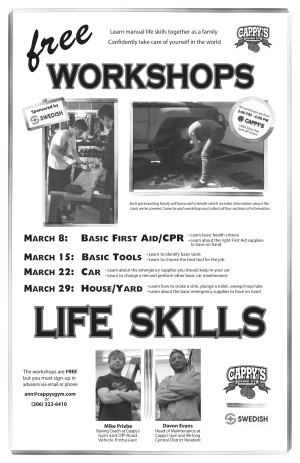
CommunityLifeSkillsWorkshopPoster2Taking care of yourself in the world isn’t always easy. Parents, do you wish your kids could get a chance to practice basic manual life skills like how to change a tire or use a ladder? Maybe you are an adult who would like to brush up on First Aid/CPR or safe ways to work out in the yard? Cappy’s Boxing Gym is hosting a series of four Community Life Skills Workshops covering:

– First Aid/CPR (March 8th, 2:00PM-4:00 PM)
– Basic Hand Tool Use (March 15th, 2:00 PM-4:00PM)
– Basic Car Maintenance/Care (March 22nd, 2:00 PM-4:00 PM)
– Basic House and Yard Care (March 29th, 2:00 PM-4:00 PM)

With sponsorship from Swedish Hospital, Cappy’s is able to offer these workshops for FREE. Workshops will be held at the Gym, 1408 22nd Ave, and are open to the Public but you must pre-register. For more information OR to sign up your family, contact [email protected] or call 206-322-6410

Valentine’s Day Workout!

Looking for something different to do on Valentine’s Day? Want to give some love to your heart muscles? Cappy’s Boxing Club is hosting a Valentine’s Day workout fundraiser for our non-profit. We’ll have treats and fun workout music! You don’t have to be a current member to participate so come on down and check it out!

Friday, February 14th from 8:00 PM-9:00 PM.

The Madrona Company planning four-story residential building at MLK and Union

Developer The Madrona Company has set its sights on 1141 MLK Jr. Way, at the corner of Union Street. There’s long been an empty lot and a small, two-story building at the address; soon, the spot will hold four-story residential building.

According to a Land Use Information Bulletin, the plans by developer Marty Liebowitz include a proposed “4-story structure containing 50 residential units and 7,500 sq. ft. of commercial space. Parking for 25 vehicles to be provided in below grade parking garage. Existing 2-story structure to be demolished.”

Back in 2008, The Stranger gave Liebowitz the title of “coolest developer in Seattle,” for his ideas to add cheap music practice spaces for “the rock-and-roll kids” who make only 10 to 20 thousand dollars a year. It’s unclear whether that vision is still a part of the design, though, as the building’s plans have undergone changes since the post. The Madrona Company also built the Central District’s Yesler Mews and Madrona’s Bowling Green building.

The public has the opportunity to learn more at an Early Design Guidance Meeting:

February 26 at 8 PM
Seattle University
1000 E James St
Student Center – Multi-Purpose Room #210

You can also comment before the meeting in writing “to assist in the preparation of the early design guidance through February 26, 2014. You are invited to offer comments regarding important site planning and design issues, which you believe, should be addressed in the design for this project.” Email [email protected] or write to:

City of Seattle – DPD – PRC
700 5th Avenue, Suite 2000
PO Box 34019
Seattle, WA  98124-4019

For more information, check out the Notice of Design Review online.

Woman suing CD Ethiopian restaurant and pushing for restaurant grading system

Seattle resident Sarah Schaht is suing Central District restaurant Ambassel Ethiopian after she contracted a debilitating E coli bacteria infection. Schaht is now crusading for a simpler grading system and to make public the grades King County health officials assign restaurants based on their latest health inspection.

As KIRO reports, “Schaht chose the Ethiopian restaurant because customers on Yelp gave it nearly four stars.  What she didn’t know was the restaurant had failed six health inspections since 2010 and had one of the worst inspection scores of any Seattle restaurant last year.” Workers were flagged for not washing their hands. Insects and rodents were spotted in the restaurant, and raw meat was being prepared on the same surfaces as cooked food. Health officials shut down Ambassel, though the owners have reopened as Laco Melza, which doesn’t yet have any Yelp reviews.

As a result of Schaht’s efforts, Seattle and King County public health officials are asking for input on their inspection system, which you can provide online.

More from KIRO:

Schaht has started a petition to pressure King County health officials to adopt a simple letter grade system, in which restaurants are required to post an A, B, C or F grade in their front window so diners know how the establishment performed on its latest inspection. Cities in nine states have letter grade requirements, including Los Angeles, San Francisco and New York City. After going to the letter grade system in 2010, New York City’s Department of Health reported a 14 percent decline in salmonella cases in the first 18 months.

In L.A. County there’s been a 20 percent drop in the number of people hospitalized with food-related illnesses.

You can sign Sarah Schaht’s online petition, and learn more about how other restaurants fared in their latest inspections.

One of three CD Nickelsville camps evicted

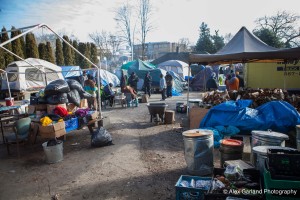
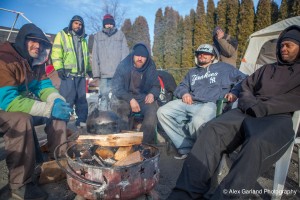
IMG_7053A bid for independence ended in a weekend eviction for one of the three Nickelsville camp sites in the Central District.

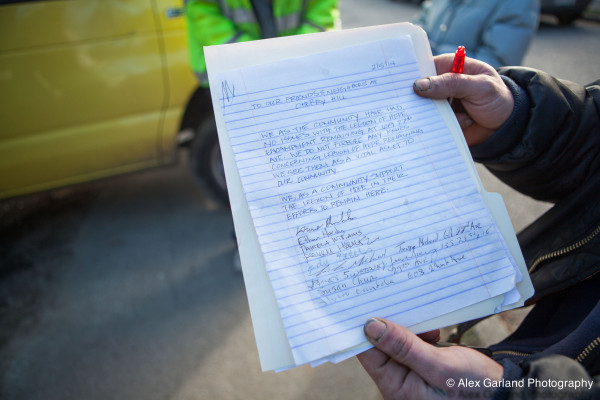
Residents at the Legion of Hope Encampment at 22nd and Cherry were notified of Cherry Hill Baptist Church’s decision to evict the camp following a vote by campers to break away from the structure of the Nickelsville sites.IMG_7072

Two more Nickelsville camps continue to operate in the area. In December, we wrote about the convergence of three Nickelsville camps arriving in the Central District and ways for those living nearby to help the communities.IMG_7034

Nickelsville residents must abide by a code of conduct, which includes a ban on alcohol and drugs, weapons, and abusive behavior. The Legion of Hope campers say there were hoping to live in a less restrictive environment and that complaints from neighbors had been minimal.

At 75 residents, the Cherry encampment had been the largest of the three camps. Nickelsville organizers are looking for locations to host the camps on a long-term basis.

In January, one of the site hosts announced its plans to develop affordable housing on its property near 20th and S. Jackson.

Liberty Bank landmark bid moves to next step

An effort to save an empty, but historically significant 1960s bank at 24th and Union got its first round of approval for landmark status Wednesday. The Seattle Landmarks Preservation Board voted to accept the nomination of the former Liberty Bank building, the first Black-owned bank in the Pacific Northwest.

The building will have to win another round of approval from the board to be preserved as an historical city landmark. The utilitarian building, which has sat empty and fenced off since KeyBank left in September, is also being considered for an affordable housing project. Capitol Hill Housing has been in negotiations with KeyBank to buy the building and erect a mixed-use development on the site.

Longtime Central District/Africatown activist Omari Garrett filed the landmark petition for the bank. He told CDNews earlier this week that his fight to preserve the bank ran deeper than just saving a building.

“Our children are not on the street shooting eachother because they dont have a place to stay. They don’t have Black institutions to look up to, they don’t see Black bank owners,” Garrett said. “Housing is not our problem in the central area. Our problem is identity and having cultural institutions in Africatown.”

Yesterday a community post from CDNews member ‘africatown’ praised the board’s vote:

Members of Seattle’s Africatown attended the meeting to continue to advocate and preserve the cultural and historic fabric of the african american central district community, now known as ‘Africatown”.

Historic preservation, economy success, education, and cultural identity all make a substantial contribution to Seattle’s Africatown community.

The success of the nomination was the right thing to do.

It was the only thing to do.

Community. Culture.

Annex brings Black Like Us premiere to Capitol Hill

February brings a new play to Annex Theatre, co-produced by Brownbox Theatre, Black Like Us by Rachel Atkins. Annex says that while its scheduling during Black History Month is intentional, it is “more than race… of the sweet, complex, and exasperating relationships that exist between sisters…The history of the Central District and the Civil rights movement in this city are woven into the narrative.”

Atkins

Atkins

11th and Pike’s Annex is no stranger to new plays, many of its presentations deliberately chosen from local playwriting submissions in a hotly contested annual company debate. Nor is Rachel Atkins a stranger to playwriting, with a long history as a writer and teacher and 20 years as a script writer for Living Voices, historically-based multimedia one-person theatrical events.

Rachel reports that as many as 3 million people have seen her work presented around the country, but most people in Seattle aren’t even aware of the (local) company. Living Voices focuses on social justice issues of many sorts: civil rights, women’s suffrage, Japanese American internment, the Holocaust (Anne Frank), immigration. All their scripts are written by Atkins and then integrated with video or archive photos, and the actor interacts with voices from the past.

“This play is about families and sisters,” Atkins said. “I wrote the play so it could be double-cast but (director) Jose Amador decided we would keep individual roles for four African American women instead of two, so there would be a maximum opportunity for more actors of color, since there are so few on stage, often.”

Atkins said this work is also purely female. “The relationships they have with each other have nothing to do with men,” she said. “I’ve gotten good feedback about that. ‘Hey, none of their problems have to do with if they’re going to get some man or keep some man.’”

Atkins said she turned to her own background to write characters of a different race. “My parents are Jewish but my step-dad, who raised me was black,” she said. “I grew up in the ‘70s when a mixed-race family was not nearly as common as now. I grew up aware of those issues and questions about race and it was a complicated situation for my mom and step-dad.”

1399205_10152170356569324_558269314_o“The play is from 1950s until today, so characters in the ‘50s speak differently than contemporary characters,” Atkins said of the language she used. “Part of this is about the assumptions we make about people and these characters needed to sound like themselves, whatever their skin color. Also, the play is set in Seattle and there is a regional sound to it.”

“I had a shorter version of this play run last year and black audience members actually talked to the characters,” she said. “I don’t think any white audience members did that. Tyrone (Brown, artistic director of Brownbox Theatre), my director, did mention that might happen because black audience members might have something to say about what was happening on stage.”

American folk tales

Also playing until February 26th on Tuesdays and Wednesdays at Annex is Story and Song. Bret Fetzer performs two American folk tales with backing a small group of singers a la the movie O Brother Where Art Thou?

For more information, go to www.annextheatre.org or call 206-728-0933.