
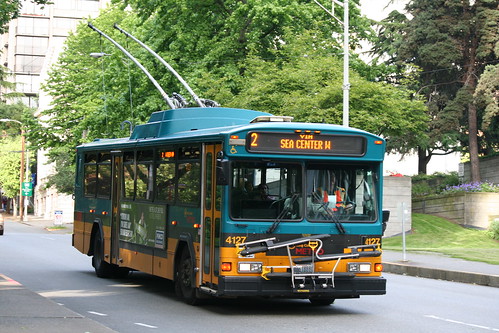
Each time we’ve talked about the county’s upcoming study on how to replace the electric trolley buses, some commenters have wondered why they need replacing at all when so much of the equipment is less than 10 years old.
But the key is that even the buses that look new on the outside are actually quite old on the inside. The 40′ buses that run on Central District routes #2, #3, #4, and #14 have relatively new bodies that were purchased in 2002. However, in an innovative cost-saving move, the county bought them without motors and simply recycled the 1970s-era propulsion systems from the old trolley buses that they replaced.
While that saved a lot of money at the time, the motors and all of the control systems are well over 30 years old now. Many components and parts are no longer available, forcing Metro mechanics to fabricate new pieces from scratch when they wear out. And over the next 6 years the county forecasts an increasing rate of propulsion system failures as all of those parts pass the end of their expected life.
We spoke to a Metro maintenance supervisor who said that one thing the county is looking at is whether they can save money the opposite way now, by only replacing the propulsion system but keeping the relatively new bus bodies. That’s one of the menu of options that will be studied before a decision is made on the trolley buses next year.
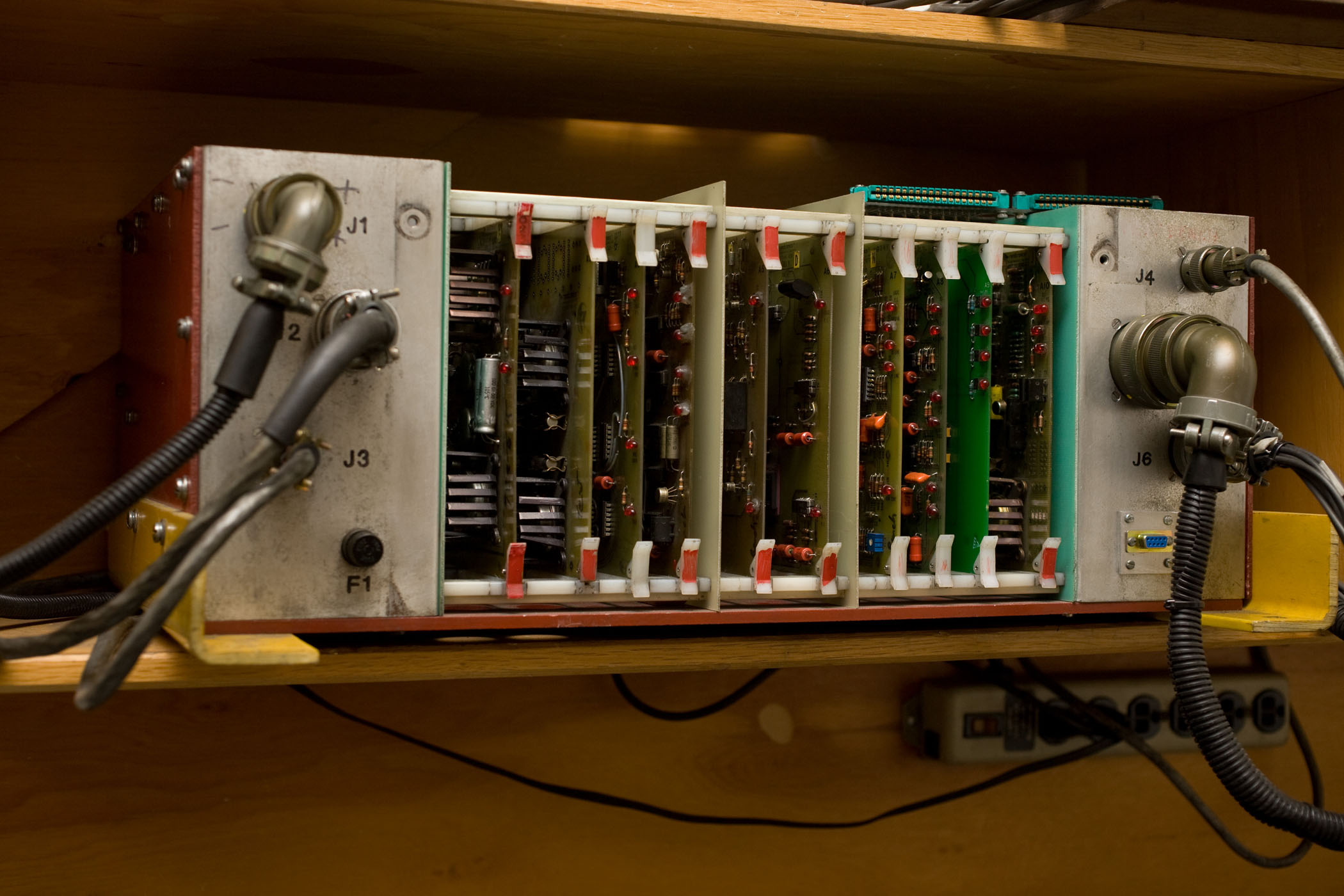 The 1970s analog computer that controls the trolley bus
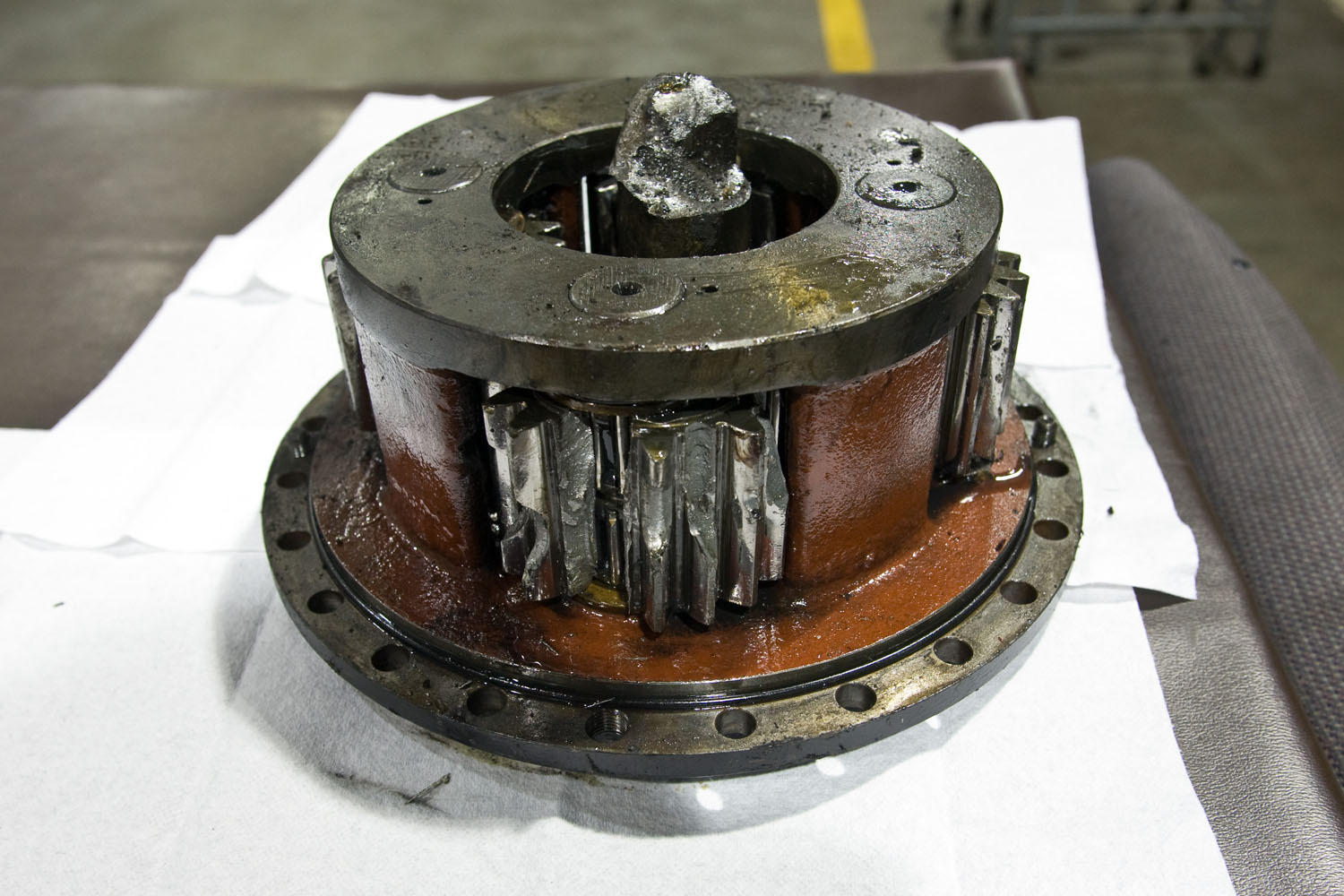 A chewed up planetary gear from a trolley bus
The other part of the trolley bus fleet is composed of the Breda articulated buses that run on busy routes like the #7 and #43. Those were purchased in the late 80s to run in the downtown bus tunnel, and originally had diesel engines that would run out on the streets and then switch to electric motors once inside the tunnel. But Metro began running new diesel hybrid buses in the tunnel in 2004, and began to switch the old Breda buses to trolley-only routes. The diesel engines were removed and they became electric-only.
The articulated trolley buses have their share of problems too. The frames are cracking, which will allow water to drip in on passengers when it rains. And the county is forecasting problems with parts on those buses too, as many are no longer available from the manufacturer and the county’s stockpile of cannibalized parts is running low.
The county expects the issues with both trolley bus models to come to a head in 2016. That will require them to order replacements in late 2011, driving the schedule of the current study that will recommend whether to order new electric trolley buses or replace them with a different technology or plain diesel buses.
that the County skimped in 2002, when we were in the middle of a boom and pretty much rolling in money?
seems like a good idea, no?
We were not in a boom economy in 2002. We were in the 2001-02 recession, the .com bust that hit the NW disproportionately hard. The last boom economy we’ve had was in the 90s.
If you’re on Facebook and want to help save electric bus service in King County, please join our group! http://www.facebook.com/group.php?gid=133395816688760
Thanks.
I drove trolleys out of Atlantic Base last winter. During a hot spell in September, one coach I was driving broke down – probably because the electronics had overheated. See below for pictures taken when the mechanic came out to work on the coach:
http://j.mp/aiGtfq
Apparently, there have been some modifications made to the trolleys to improve cooling in this area and that has improved reliability a bit. That said, the circuit boards reminded me of circuit boards I had seen when I worked on Computers in the early 80’s. Definitely old technology.
They need to buy some new trolleybuses. Like the ones in Vancouver.
You have no idea how wonderful the auxiliary Diesel engine feature is in Philadelphia. It’s used almost daily for many reasons. The slightest problem such as a fire, police activity, parades, street protests, neighborhood fairs, accidents, double parking, etc., used to completely disable a trackless trolley line. Yes, they’re called trackless trolleys in Philly as well as Boston. Costly replacement buses had to be pressed into service to maintain the schedule. Passengers waiting for trackless trolleys to get to work, school, doctor’s appointments, etc., were left standing on corners {in heat, rain storms, freezing cold, ice, snow} wondering what happened. They were not happy !!
With the new, wonderful EPU {off-wire} feature, the operator flicks a dashboard switch and the trolley poles automatically lower. Another switch turns on the Diesel engine and off goes the coach around the blockade. And a street supervisor doesn’t even have to get involved. The two way radio system informs the supervisors of detours and problems. Rarely do they even have to respond. It also informs the operators of what to expect. Service is maintained and costly replacement buses are not needed. Delays in service and gaps are kept to a minimum. A transit system can not afford to keep fleets of Diesel buses in reserve for emergencies or bus operators sitting around just in case an unforeseen problem arises. Riders must not be unduly inconvienced, if they are to continue using public transit.
And there are long term detours such as street construction, water main breaks and repairs, overhead wire or electrical work, gas main work, loop paving or construction, etc. In the old days, the trackless trolley line would have had to be temporarily converted to buses for days or even weeks. This is no longer the case. The Diesel bus fleet is not stretched beyond its normal capacity to “cover” for trackless trolleys. Buses do not have to be kept in reserve for such emergencies. Trackless trolley service continues and trackless trolleys now have all of the flexibility of Diesel buses. No longer can that issue be “held against” trackless trolleys. It is no longer a detriment to operating an electric trolley coach system.
Anyone who drove the Breda coaches when they were dual (diesel/electric)mode buses can tell you they were anything but “good”. While the concept may have been “good”, the implementation fell flat on its face. As an operator, I fully expected to need a Breda coach replaced before my shift was over any given day. Having said that, after driving all electric trolleys for several years now, (including the “all electric” Bredas), I find them to be clean, quiet, powerful and over all reliable. I’ve had far fewer trolley problems than diesel problems in the past 10 years. The often over loaded trolleys buzzing up James st. and the counter-balance far out perform their diesel and hybrid counterparts.