


Atomic Bombshells in “Lost in Space” (photo by Michael Doucette)
Like a little glitter with your science fiction?
Let’s be real. A lot of glitter. The burlesque troupe Atomic Bombshells are currently performing their third run of “Lost in Space,” a show that is self-described as “an intergalactic voyage of sight and sound, filled with alluring aliens, slinky space adventurers, bodacious Barbarellas, and planetary princesses.
One of those planetary princesses is Central District resident and award-winning burlesque performer Indigo Blue. We sat down with her ahead of opening night to learn more about her burlesque career.
You can catch “Lost in Space” every night at the Triple Door until November 16. For tickets and more information visit www.tripledoor.net or call 206-838-4333.
CD News: How did you first get started with burlesque?

Indigo Blue (photo by POCPhoto)
Indigo Blue: I first started performing burlesque acts in Tamara The Trapeze Lady’s cabaret show in the early ’90’s called “The Fallen Women Follies.” Tamara is also a CD-dweller, and at the time we lived right around the corner from each other. Her cabaret was the first opportunity I had in Seattle to perform on a public stage other than as a go-go dancer or fashion show model. By the time Kitten La Rue and Fanny n’ Flames moved from New Orleans to Seattle just over 10 years ago, I was directing my own troupe and teaching Burlesque classes at the Home Alive Studio. I was really excited about Kitten’s vision of The Atomic Bombshells, and happy to be invited to join the troupe.
CDN: Are you from Seattle?
IB: I was born in Northern California and came to Seattle to go to school at UW. I fell in love with the city and haven’t been able to leave since!
CDN: Any favorite CD restaurants, bars, businesses, or other spots?
IB: I live near MLK and Jackson, a vibrant section of the CD. I used to teach Burlesque classes at Every Body Health and Fitness and really appreciate that the owners have been able to keep a small local neighborhood gym open for so many years. I love the community classes at Samarya yoga center on Yesler. As far as local eateries, I love Meskel Ethiopian on Cherry and I am so sad about the closing of Mesob on Jefferson! It’s fun to have business meetings at the Broadcast Coffee shop on the corner of Yesler and 20th. I get all my fancy hairpieces and supplies right around the corner at Western Beauty Supply in the 23 Promenade. And the Central Cinema on Union is my favorite place to see the regularly playing, locally made cult film “Waxie Moon in Fallen Jewel” (co-starring AB members Lou Henry Hoover and Inga Ingenue).
CDN: What have been some of your favorite performances?
IB: What stands out for me are the incredible opportunities I have had with the Atomic Bombshells to perform in gorgeous far-away locations like Shanghai, China and Lisbon, Portugal.
CDN: What’s unique or interesting about the Seattle burlesque scene compared to other cities?
IB: The Seattle burlesque scene is known for its wealth of international award-winning and talented performers (including Atomic Bombshells members Inga Ingenue, Miss Viva Las Vegas 2011; Lily Verlaine, 2d Runner Up Miss Exotic World 2011; and myself, Queen of Burlesque – Miss Exotic World 2011), who execute humorous and well-developed acts. We are considered to have a strong community and collaborative ethic. Many cities struggle with divisiveness and competition, but Seattle has had comparatively less of that than other cities.
CDN: What’s a surprising or little-known fact or aspect of burlesque? Or something audiences take for granted?
IB: A single burlesque act can take well over a year to develop including the highly technical quick-release costuming, choreography and story arc development, and rehearsal. We often work with other talented artists such as dressmakers, music editors, prop-builders, and mentors to craft and build our routines. And on the day of a performance, it can take 3 or more hours for a performer to prepare for one 5-minute act. It is a carefully crafted theatrical art form that requires significant time and work to execute! We hope that it looks effortless once we are actually on stage.
CDN: Any upcoming projects you’d like to tell us about?
IB: There are lots of exciting things in the Atomic Bombshell’s future – but for now, I can tell you to plan ahead for Valentine’s Day with our fantastic J’Adore show at the Triple Door!
LIHI partners with Home Depot to build shelters at Nickelsville
The Jackson Street Nickelsville homeless encampment will be receiving sleeping structures and tent platforms tomorrow, courtesy of a partnership between the Low Income Housing Institute (LIHI) and The Home Depot Foundation.
LIHI and Home Depot have assembled a group of 80 volunteers, 65 of which are Home Depot Associates, to build a total of six tent platforms and three sleeping structures at the homeless encampment at 2020 S. Jackson Street. Volunteers are also slated to paint the encampment’s existing sleeping structures, install a new storage unit for food and donations, and build a play area for children.
The project honors Veteran’s Day and the estimated 10 veterans living at the Jackson Street encampment. Recent data from the National Coalition of Homeless Veterans counts 76,229 homeless veterans. LIHI says it has made housing veterans a priority, providing homes to 400 single veterans and veterans with families and serving an estimated 1,750 veterans each year at hygiene centers called Urban Rest Stops.
“We thank The Home Depot Foundation for providing a grant of $14,000 for LIHI to purchase building materials for the tent platforms, sleeping structures, and children’s play area as well as paint, concrete blocks and a storage shed so that homeless families including veterans can have a safe place to live at Nickelsville”, said Sharon Lee, LIHI’s Executive Director, in a press release. “With the help of Home Depot volunteers, we can help end homelessness for veterans.”
The People of the Central Area: Dee Goto
This post is first in a series of profiles of Central District residents, part of the “People of the Central Area” project developed and written by Madeline Crowley.
Dee Goto, Author, Business Owner & JCCCW Founders Group
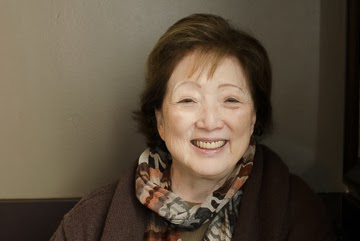
Dee Goto (photo credit: Madeline Crowley)
you down seven times, you get up eight.
About Dee: Dee Goto is an author who also kept working (with many others) over many years to make the Japanese Cultural & Community Center in the Central Area a reality.
When did you live in the Central Area?
In 1960, I had been accepted in the University of Washington nursing program in public health. I worked nine months full time at King County Hospital before I started school and then worked part time at Swedish Hospital. I came to school here from Oregon because my grandfather wanted me to go to school in Seattle; his roots in America were here.
When I got here and started looking for an apartment, my housemates and I were turned away from three different buildings before we could find one that would rent to Japanese.
In 1960? It’s interesting to learn that even in the Central Area with redlining there were further restrictions on renting to Japanese-Americans.
We ended up living at the Monticello Apartments. At that time I was studying at the Japanese Language School. My future husband’s younger sister was a classmate. I didn’t have a car and she offered to drive me home so that’s how I developed a relationship with my husband. We married on Christmas Eve in 1961.
Once you got married where did you and your husband live?
On 23rd Ave, near Holy Names. That house is still there right as you turn downhill towards the University, if you didn’t turn you’d run right into the house.
What was that neighborhood like in 1968?
When we first moved in a neighbor came over very excited that we were Japanese-Americans and were moving in.
In 1968, I was unaware of the incarceration/internment problems that had taken place in the Central Area in the ‘40s.
You grew up on the other side of the Cascades?
Not only that. We went to the incarceration/internment camp to visit and I thought they (the Japanese internees) were having a great time. Back then, we lived on a farm in Idaho, we had relocated before the war and didn’t have to go to the camp because we lived outside the restricted zone which was 400-miles from the coast.
We visited Minidoka because many of our friends were there. Living on a farm, we didn’t have neighbors very close by so when I visited it seemed like the kids in camp were all having a lot of fun. My mother particularly envied all the craft classes the ladies were taking. Also, she noticed the women didn’t have to cook. My 21 year-old Uncle worked hard during the week so he could drive to Minidoka for the Saturday night dances. Despite what seemed like the good times they were having while incarcerated, our family wouldn’t consider trading places. We knew freedom was most important.
You started talking earlier about the composition of your neighborhood on 23rd.
There was two black families across the street and one Japanese family a few doors down, the Hayashis, another black family three doors down. There were the Vogels, Germans, across the street.
We knew everybody for about 2-3 blocks; we were pretty close. I organized Block Parties. Our kids played outside with all the other kids, they all were playing in our yard. I had doors open so there were kids running through our house. One day a kid knocked our television off its stand. There were trikes and bikes all over in our yard. I found a photo last night of the kids making a train of these toy vehicles.
Because the kids were always playing in the street, I organized a kitchen conference and got all these signatures to get curbing put in on 23rd Avenue so the cars couldn’t rush in. That was one of the first neighborhood traffic diversions. Since then, the Department of Transportation made lots of diversionary traffic controls in the streets of Seattle but that was one of the first ones.
Another thing I learned was that after Minidoka a high percentage of people didn’t come back to the Central Area. I wonder why?
I think their feeling about the discrimination they’d faced. Some were willing to fight for what they had while others were not entrepreneurial and business-savvy so they didn’t come back and went to work for someone else. There was a time, even if one had a college degree they wouldn’t be hired. The war eased that and Japanese were known to be honest and hard workers.
With discrimination you had to be pretty self-reliant and savvy to fight through it. I think some people took the easy way out and became employees rather than business-owners. The business owners who came back are the focus of my book on the Lion’s. You needed to be strong. Discrimination in a way helped some become stronger.
New City Theater and Coyote Central receive City funding for upgrades
Mayor Mike McGinn recently announced funding for upgrades to cultural facilities throughout Seattle. The city will award a total of $250,000 to 13 cultural and arts organizations for projects like elevator upgrades, seating risers, and new stages and electrical systems.
Two of these projects are located in the Central District, including $9,000 to Coyote Central for improvements to wood and metal shops (ventilation, heat, and safety) and $6,900 to the New City Theater for the installation of new audience risers to expand capacity by 39 percent.
“These investments will help our cultural institutions remain a vital part of our neighborhoods,” said Mayor McGinn in a press release. “Upgrading aging facilities can help these institutions focus on maintaining their programs and bringing arts and culture to the people.”
More about the funding program from the Office of Arts & Culture:
The cultural facilities program, piloted in 2012, supports Seattle-based arts, heritage, cultural and arts service organizations with one-time funding for facility renovations or the completion of the final phase of new facilities. After a successful pilot year in 2012 in which $150,000 was distributed, Mayor McGinn and the City Council increased the allocation to $250,000 for 2013.
All projects receiving this funding will take place and be completed between now and December 2014. To view a full list of projects that received this funding, click here.
Central District band Mutiny Mutiny to release second album
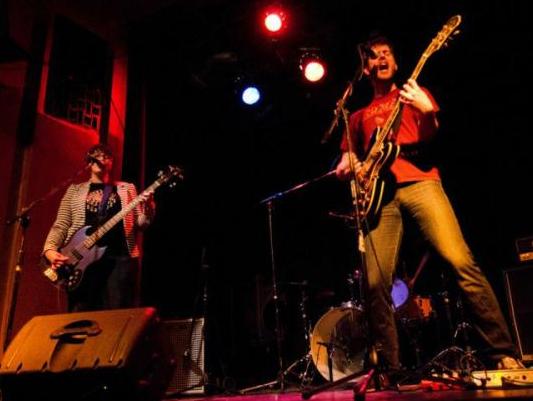
Mutiny Mutiny performing live (photo courtesy of the band)
From garage bands to Jimi Hendrix, the Central District has a long history of musically-inclined residents. For the past few years, the post-punk band Mutiny Mutiny has contributed to that legacy.The two-person band includes guitarist Jason Dean and bassist Jenn Schmidt. Dean and Schmidt moved to the Central District a few years ago, and since then have drawn inspiration from the neighborhood — from the diversity and history here to the tragedy of Justin Ferrari’s shooting.
Mutiny Mutiny is poised to release their second album, and they’ll be playing a release show at the Columbia City Theater on November 14 at 8pm. CD News sat down with the band to talk about their new album.
CD News: What can listeners expect from the new record?
Mutiny Mutiny: We are very proud of this record, and really hope that listeners will enjoy it. We worked with an awesome producer, Brandon Busch, who really has a good pair of ears and he helped us get the best audio quality that we could. He did a great job, and things are really sounding awesome. The songs on the new record are pretty diverse. We have some faster, angry songs, some slower, moodier ones, some that are really weird and angular, and some that are more melodic. Jenn played classical music for a long time, so our song structures don’t necessarily follow what you’d expect from a typical rock band. They meander a little bit and go where they want to go, which we think is cool. We also worked with a really talented local artist, Stacy Hsu, for our cover art. It turned out amazing and that is 100% because of her.
CDN: What aspect are you most proud of?
MM: We are really proud of the batch of songs we’ve written and the performances we were able to capture on the record. Some feedback we got on our first album was that we sounded a little tentative and like we were holding back a little bit in the studio, which was probably true. This time around we really tried to step it up and bring a lot more energy and better performance to our songs. We also spent a lot of time working on writing stronger vocal parts and using harmonies more. Overall, we feel like this record is a big step forward for us and we’re excited to be able to start sharing it with people.
CDN: How has life in the CD influenced your music?
MM: Well, when you live in a neighborhood that’s produced amazing musicians like Jimi Hendrix and Quincy Jones you better step up your game if you’re going to represent the CD musically. It is such a dynamic neighborhood and we feel lucky to live here. There is constant activity and change, which generates lots of food for thought. You have boxing gyms, some of the best Ethopian food in the country, Hollow Earth Radio and places like The Wild Cat Cafe. We get a lot of inspiration from the energy and diversity of the community. There is a lot going on here, and when you mix that with the deep roots and strong sense of community there’s no shortage of inspiration for new songs.
CDN: Was the “Senseless Theater” song a way to cope with the tragedy of the Justin Ferrari shooting or a way to speak out on a large scale?
MM: Senseless Theater was written both as a coping song and as an attempt to speak out on a larger scale about the many instances of gun violence that have happened in Seattle this past year, one of which was the Justin Ferrari shooting. We live just a couple of blocks from the intersection where that happened and walk or drive through there pretty much every day. The absolute randomness and senseless nature of that incident really hit hard. It really could have been anyone. Not long after that, we were woken up by gunshots right out in front of our house. Our neighbors two doors down actually had bullets come in through their front walls. Jason was going to the studio the next day, and he finished the words to the song on the bus on the way there after that night while the police were walking around outside looking for casings. We tried to capture the sense of fear and paranoia that its impossible not to feel when acts of random and senseless violence take place so close to home.
Look for more upcoming shows from Mutiny Mutiny, to be announced on their website.
You can listen to a track from the band’s album here:
Changes and cuts possible for Central District bus routes
Major changes and cuts to many of Seattle’s bus routes loom if lawmakers don’t take steps to shore up King County Metro’s budget. Metro’s proposed service cuts include eliminating routes 4 and 27 entirely and changing routes 2, 3, 7 and others.
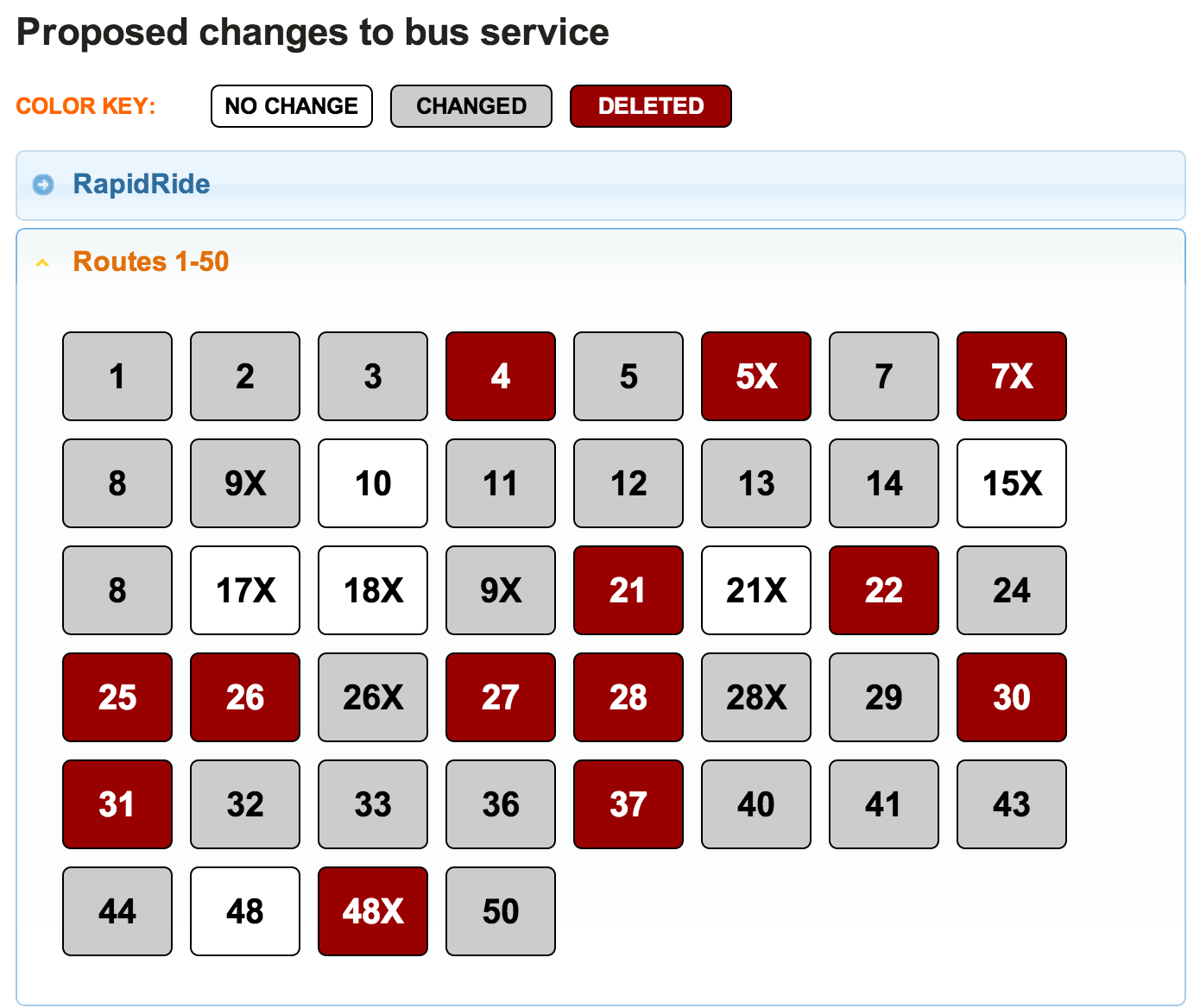
Metro says they’ve taken steps to avoid coming to this point, having already cut costs, raised fares, and put other efficiencies in place. But temporary funding from the state expires in June, and if lawmakers don’t step in, we’ll see drastic route reductions city-wide. Metro proposes eliminating 74 routes and changing 107 routes, resulting in 33 routes likely becoming more crowded. Though a bit of a scare tactic to spur Olympia to action, this could become a reality.
You can provide feedback on the cutbacks to [email protected]. A meeting will be held December 10th in downtown Seattle to discuss the cuts.
Downtown Seattle Service Reduction Public Meeting
Tue, December 10, 12pm – 2pm
Where: Union Station, 401 S Jackson Street, Seattle
Created by [email protected]
Description: Come talk with Metro staff about the service reduction proposal. The meeting will be an open house format – with the option to participate in a short, interactive presentation and small group discussion from 1-1:30 pm.
You can also provide feedback via Metro’s service survey. The entirety of the cutback plan once short term funding dries up next June is available here.
SPD arrests man after he broke into ex-girlfriend’s Central District home
The Seattle Police Department blotter has the story:
East Precinct officers responded to a report of a burglary in progress just after midnight near 26th Avenue and East Pine Street. As officers were enroute, the 911 operator was told by the victim that the man coming through her bathroom window might be her ex-boyfriend. The operator also heard the victim yelling at someone to get off her bed and get off her before the line was disconnected.
Officers quickly arrived at the house and were met by the victim. She indicated that the suspect, her ex, had fled to the basement. Officers went down to the basement where they could see the suspect hiding inside a crawl space, trying to conceal himself with insulation. Officers were able to get the suspect to climb out of the crawl space and arrested him.
The vicitm told officers that the suspect is her ex-boyfriend and that he had climbed through a previously broken window. She also told officers that as she was on the phone with 911, he had grabbed her and forced her out of her bedroom into the living room. He grabbed the phone from her hand and disconnected with 911 before throwing the phone to the floor. It was at that point that officers were at the front door, so he fled to the basement.
The suspect gave officers several different names before finally admitting to his true identity. Officers located several outstanding warrants for his arrest, as well as a Domestic Violence No-Contact Order with the victim listed as the protected person. The 24-year-old man was later booked into the King County Jail for Investigation of Burglary, Investigation of DV Assault, the outstanding warrants, and officers are requesting the additional charge of interferring with the reporting of domestic violence assault. Detectives will handle the follow up investigation.
Pratt Fine Arts Center offering free Veterans Glassblowing Day
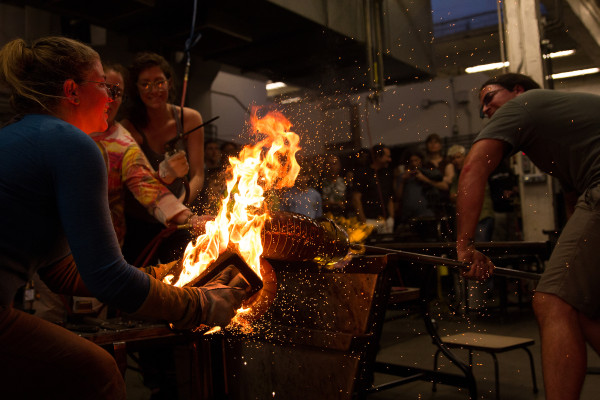
A recent glassblowing demonstration at the Pratt Fine Arts Center. (photo by Alec Miller)
The Pratt Fine Arts Center is hosting free Glassblowing classes for all veterans and their families this Saturday, November 9. Pratt’s classes are part of a nationwide initiative to offer free glassblowing instruction to veterans in honor of Veterans Day on Monday
“The goal of the event is to expose men and women to the world of glass art as well as affording troops the chance to develop a technical skill. Veterans Glassblowing Day hopes to unify the glassblowing community, and bring awareness to the craft and various organizations through their involvement,” Pratt announced in a press release.
The instruction will be split into two sessions, with a morning group from 9:30am to 1:30pm and an afternoon group from 1:45pm to 5:45pm.
Veterans and their families can sign up online www.pratt.org/classes
Organizations participating in the Veterans Glassblowing Day hope to make these classes a permanent opportunity, starting a nonprofit that offers scholarships for veterans to learn glassblowing and secure apprenticeships with professional artists. They’ll then have a marketable skill and the invaluable ability to self-express through art.
Clean Greens secures donated solar power system
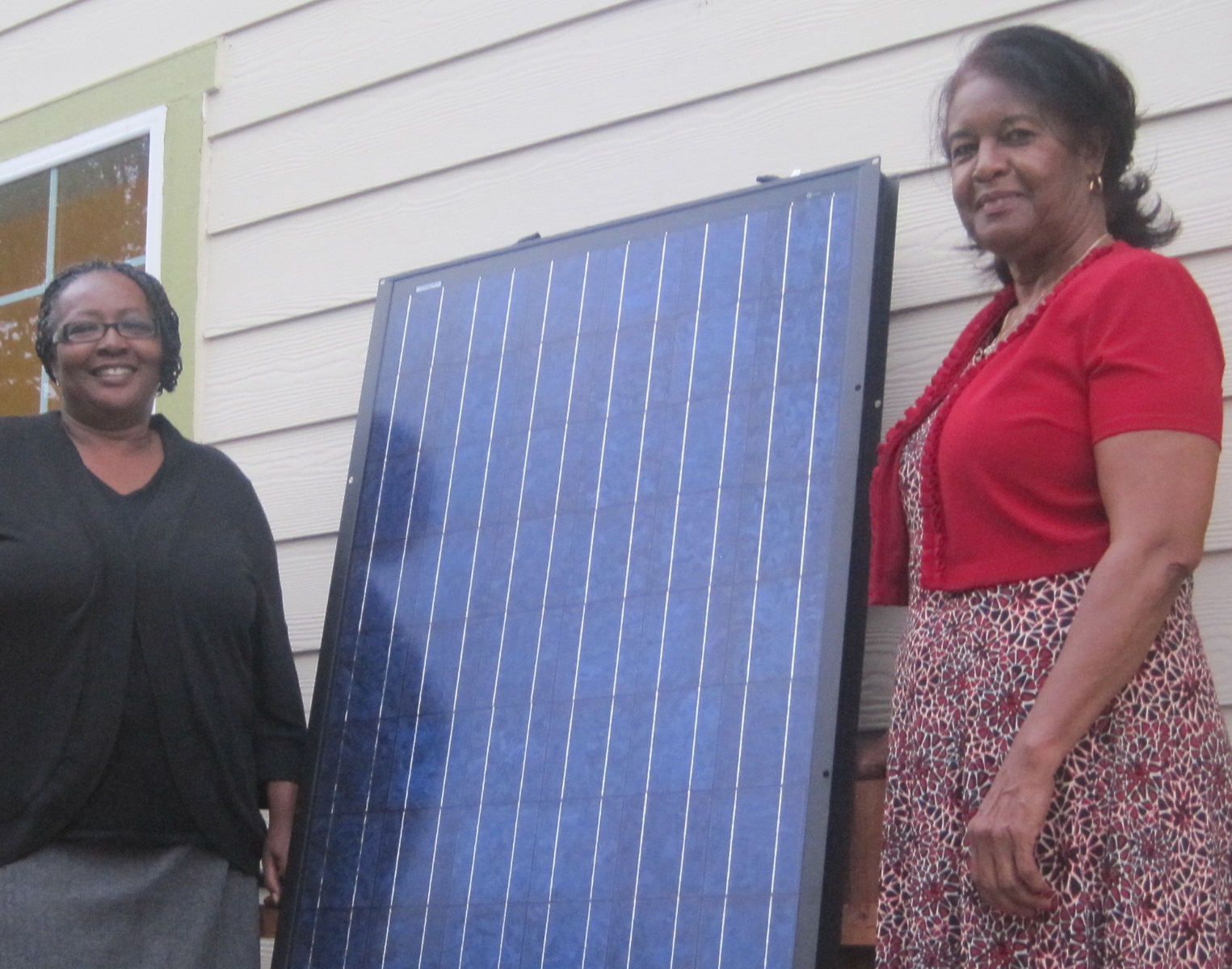
Cheryl Peterson (board member) and Lottie Cross (director) of Clean Greens Farm & Market (photo courtesy of Solarize Seattle).
Solarize Seattle has just announced that it successfully exceeded its goal to sign 60 contracts for solar power systems at homes and businesses in Central Seattle. In fact, Solarize Seattle has 65 contracts signed for systems in the area, meaning Central District nonprofit Clean Greens Farm & Market (along with Bike Works) will receive donated 3 kW solar systems.
The donation is a project of Solarize Seattle, part of Northwest Sustainable Energy for Economic Development (Northwest SEED) and Seattle City Light. It aims to increase solar energy installations through a group purchase, which will bring down the price for each home. To participate in the project, you must have attended one of several free public workshops to learn more about solar energy and to receive a free site assessment for your home or business.
Solarize Seattle is still conducting site assessments and is hoping to get another 35 customers on board, bringing their total to 100.
Central District resident captures history of the neighborhood through personal stories
Just after Justin Ferrari’s shooting death, Central District resident Madeline Crowley began attending community meetings, where she noticed “people weren’t really listening to each other.” Crowley says that despite the neighborhood’s diversity, there seemed to be a lack of connection to the past, and to each other.
“My hope is that if we hear each other’s stories, that may facilitate some openness and
Madeline Crowley’s Central District history project website
bridge gaps,” Crowley says. “Besides, the history of this neighborhood and the personalities in it are fascinating.”
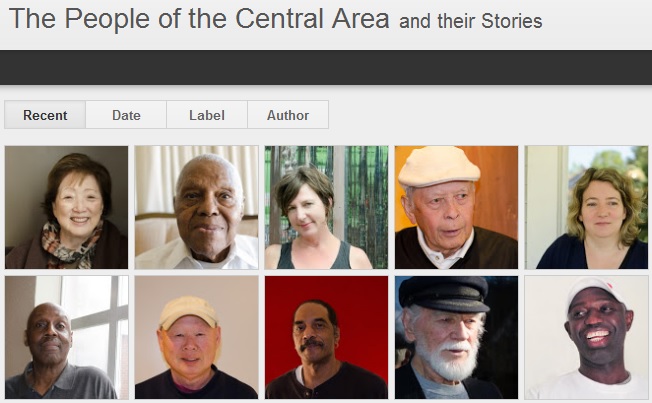
Crowley set out to document the neighborhood’s history through the stories of its residents through a project she calls “The People of the Central Area.” She’s posting her interviews, which now number 17, on a blog here. Crowley started her project in November 2012 with an interview with John Platt of St. Clouds restaurant. She plans to interview about 30 to 50 people in total, wrapping up the project about this time next year.
Crowley had a lot to say about her favorite experiences working on the project:
It’s enlarged my sense of the Central Area and changed its ‘geography’ for me. I drive down a street and see a house that I now know was occupied by a young Sephardic girl in the 1920s. It’s nearby another house where a young Chinese boy played kick the can in the street with his two best friends, a Japanese kid and an African-American kid in the 1940s.
The neighborhood is now becoming populated (for me) with other people’s memories. Since I didn’t grow up here this has added immeasurably to my love of the area.
More importantly, though, is that it’s enlarged my small experience of the world. If I listen to people carefully I learn what it might have been like to be sent from your home, from most of your possessions, to see your parents stripped of their business and to grow up in an American concentration camp as happened to the Japanese-American population in the 1940s (they were the largest ethnic group in this neighborhood at that time).
Or in another example, I’ve listened to what it was like to hide from the police in a backyard during the Black Panther period, and what it was like to be a white neighbor of the Black Panthers who knew them and supported them. While in other cases, when someone lived further away and didn’t know the Panthers personally, they were afraid during their marches. All of these things are ‘true’ in that they reflect the different experiences of people living in the neighborhood.
I’m interested in each person’s ‘truth’ in their story, not in finding a singular truth as I don’t believe memories function that way.
We plan to reprint excerpts of Crowley’s interviews on occasion. In the meantime, you can read them on her website, and donate to keep her project going.