
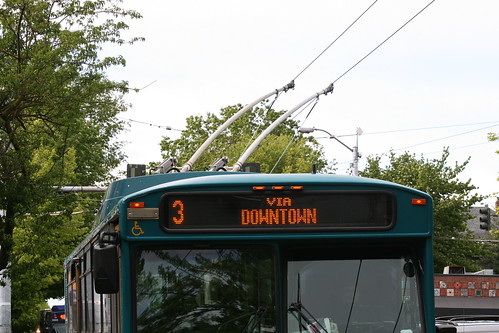
The final decision on whether or not to keep the trolley buses will be made by the King County Council. And whether or not electric buses will save the county money over the long term, there’s a cold political reality to the county council’s decision: Out of nine county council members, only two have any trolley buses in their districts.
That fact could easily open up the trolley decision to the long-standing divide between Seattle and the surrounding regional government. Perceived equities in Metro funding has always been a key part of that, which resulted in the infamous 80/20 rule that devotes 80% of new transit hours to the suburbs, even when multiple Seattle bus routes run at standing-room-only conditions.
On the other side, everyone in Seattle city government who has spoken out on the trolley bus issue has been in support of keeping them. So with a potential city/county divide on the issue, the question becomes: what could the city offer to keep the trolley buses around.
As we discussed last month, the trolley bus network runs on cheap hydropower from Seattle City Light. Metro is a big customer for city power. Each day the electric buses use the equivalent of hundres of houses worth of electricity.
The county currently doesn’t get a break on those power costs, paying the standard commercial rate of about six cents per kilowatt hour. Other large commercial users, such as the Nucor steel mill, do pay lower rates. However, in those cases the rate is usually for off-peak hours when the utility has energy to spare, an option that’s not feasible for a transit system that runs 20 hours a day.
But it’s conceivable that the city could decide that the environmental benefits of electric buses are worth a subsidy on that power cost. A 30% cut in electric rates would save the county about $5 million dollars over the next 20 years. However, that’s just 11% of the $44 million cost of new trolley buses when the existing fleet wears out.
The bigger cost driver of trolley buses is the maintenance of the network of overhead wires. The county maintains a crew of linesmen that are always on hand to fix breaks, do routine maintenance, and to relocate wire when needed due to construction projects or other factors.
However, that’s an area that the city could conceivably help out with too. Seattle City Light already has a big crew of linemen that build and maintain the network of wires that deliver power to customers all over the region. That could allow the city to take over trolley bus line maintenance and save the county a hundred million dollars over the next 20 years – more than enough to make up any gap between the county budget and the cost of new trolleys.
The question would be how much it would cost the city to take that over. It’s reasonable to think that the city could do it for much less than the county, given the city’s existing efficiency of scale and expertise in electrical distribution. And it may be possible to fashion a compromise where the county pays the city some additional rate to cover the cost of the infrastructure work, while still saving enough to make the trolley buses a smart financial move.
Given the realities of the county’s budget problems and politics, a win/win compromise may be the best way to keep quiet, non-polluting electric buses running in the city.
Scott, this is the kind of thinking that should be presented to the City Council on June 16th at noon. They are having a meeting to deal specifically with the trolley bus replacement issue.
Thanks for the great reporting on this issue. I hope enough pressure can be bought to bear to keep these trolley lines. We got rid of them once, back in the 70’s or so, and had to re-invent the wheel.
A few questions, however….
1.) Are you sure about that rate? I was under the impression that Metro basically buys their power wholesale from City Light, and then converts it to their operating voltage at several substations throughout the town. That sort of arrangement usually calls for a wholesale rate.
If they don’t already have a special rate, I can’t see why they couldn’t. It would probably take an act of council, however.
2.) The labor question is dicier. While it’s all electricity, it’s a different skillset (different voltages, different materials, different techniques, different work and safety rules, etc). There would probably still have to be a dedicated crew – just paid out of the City Light payroll. That’s another tough one, not only for the council, but for the IBEW (Electrician’s union). The IBEW probably wouldn’t care, as long as there would be no net reduction in workers, but how would CL be reimbursed for those expenses? City regulations (and probably state as well) are pretty clear about how money can and cannot be spent. It might just end up that City Light would bill Metro, which wouldn’t result in any savings. Also, from a labor standpoint, contractural obligations differ by governmental entity – it could be that the city would end up taking on some obligations they are not prepared to meet.
I have a feeling that the better rate would be about the best the city can do, but that’s far above my paygrade. Maybe there will be some creative thinking applied to this issue.
Hello Scott,
Thanks for the meeting notice. Not sure the role of the City Council since the Capitol Hill News Blog has a statement by Larry Phillips that he created a regional task force in Sept that will determine the issue. See his statement for details here on the people to reach out and communicate your support for metro trolley buses:
http://www.capitolhillseattle.com/2010/05/13/the-facts-about
While the ridiculous discussion goes on of abandoning an electrically operated transit system that obtains its power from a clean, green hydro-electric source, millions of gallons of oil continue to spill into the Gulf of Mexico. Obviously, the officials at the King County Council still don’t get it, or this embarrassing discussion wouldn’t even be taking place. It makes one wonder just what motivates these people. Rational minds would understand that we need to get off of oil in North America. We certainly don’t need to find more ways to burn it and be more dependent on it. Perhaps the King County officials own lots of oil stock. Nothing else would make much sense.
And as I’ve stated previously, pollution is illegal. Federal funds to buy Diesel buses {hybrid or straight Diesel} can not be obtained if it’s determined that they would replace a clean, green, pollution free, zero emission transit fleet. Any good lawyer could put a stop to it. And any public officials aiding in the wanton destruction of valuable public property {the overhead wire infrastructure} should go to prison. I rest my case…..
In some cities the management of the transit system is too lazy or incompetent to run a trolleybus network properly (Edmonton being a case in point)leading to waste and political pressure to do the wrong thing. This is NOT the case in Seattle, where the management runs an efficient system well and is supportive of retaining it.
The cost of the infrastructure is a small price to pay for the huge reduction in noise and atmospheric pollution and the superior ride comfort which the trolleybuses offer.
The higher cost of buying new trolleybuses is partly due to the “buy American” legislation. Both Russia and China build perfectly serviceable vehicles at a much lower cost. If the Federal Government wishes the vehicles to be sourced only in America they should pay the difference. Remember too that trolleybuses can last up to three times as long as diesel / hybrid alternatives, so over their lifetime the cost balances out. Seattle has already shown that if the fleet needs to be modernised, you don’t need a new bus, just a new body on the old chassis or reuse of electrical equipment.
Remember – in some ways trolleybuses are like any other bus, but in every other way they are vastly superior.
Several things:
First: A trolleybus uses about as much power as three or four household loads. We have about 150 electric buses in service, so we’re looking at the equivalent of 600 houses. I don’t know exactly how many households there are in the city, but this is clearly lost in the noise as far as power consumption is concerned.
Second: We own the power supply, which is ultimately solar, and thus completely renewable.
Third: The present fleet is no where near worn out. The idea that electric buses have a predictable and finite lifetime is an entirely unreasonable application of some difficult-to-understand Federal standard for measuring the service life of motor coaches, which have hundreds of parts wearing out rapidly. The drive train in a trolleybus has at most thirty moving parts, large and rugged and not wearing out at all quickly. (Valpariso, Chile, is running a quite serviceable trolleybus system with a fleet of 1947 Pullman Standard coaches.
Fourth: Replacement of trolleybuses with diesel hybrids (which are mostly diesel) means a jump in pollution from zero to quite a lot, both from fumes and noise.
Anyone who has paid the least bit of attention to peak oil questions will know that oil is going to be very much more expensive fairly soon.
We should be increasing the size of the electric bus system as fast as possible, even considering extending lines into the suburbs. Long routes are quite practical (there is one run in Ukraine that is fifty-two miles, including a 2500 foot mountain pass).
We had to mobilize back in the ’60’s on this same issue, when Seattle Transit tried to tear down the entire system (there were some very suspect motives). We did manage to save enough of the system that there was something for METRO to rebuild with some extensions (Ballard, particularly) in 1978.
Lean on your County Councilman to preserve and expand electric bus service. I’m going to. Thanks for listening.
The cost of the trolleybus ride is divided about 60/40 electric overhead maintaice/electricity spent. This is what we have according to prices and conditions here in Sofia, Bulgaria. Trolleybuses allow us to keep closer intervals like 5 mins. We made calculations that if we change trolleybuses to buses we can`t affort to have such close interval bacause the the fuel forms 80% of bus sevrive cost.
The price of petrol here in Europe is much higher than in the USA, this is why trolleybuses here are cheaper to maintain than diesel buses. We are developing our trolleybus system and we expect 30 news Skoda/Solaris trolleybuses this September.
The world is expecting petrol shortages and shock in prices in like 5 years. When you, americans, have prices like ours, trolleybues will be cheaper to maintain. The price of electricity is more predictable. I am not going to comment the enviromental advantages.
Just keep your trolleybus system and develop it. The bigger the system, the smaller the price for one ride.
Greetings from Sofia.
I think many of the pro-trolley bus points made above are good. One quick note about the buy American stuff though – I would urge extreme caution in terms of sourcing equipment. Many of the trolley busses that need to be replaced are our Italian-made Bredas. Sure they’ve lasted a long time (at least once they were gutted from dual power vehicles to electric only vehicles at great cost) but they’ve been a terrible maintenance burden on Metro. Add to that the fact that the Bredas are so damn heavy they destroy every street they run on (read-sincerely painful additional maintenance cost) and you see some of the perils of buying less than ideal equipment because it’s cheap. The 40′ Gillig busses Metro uses that came from California on the other hand have been great. They’re old now and remarkably reliable and have had a great run (over a million miles on many of them). Ironically Metros shorter trolley busses are just Gilligs that have received the leftover motors from other retired trolleys in place of their diesel power plants.
How many of the people making this decision for us ride the trolleys as well as diesel busses? Probably not many. I ride both every day. There is a world of difference. Take away the trolleys and you will not only extinguish a self-sufficient/locally powered source of transit, but you’ll also take away a bit of inner-Seattle character. This is a hilly, rainy burb – the trolleys are probably the best, most comfortable way (other than via Gondola) to get up many of the nasty, car-congested hills in town.
Metro should maintain an *efficient* mix of equipment. If you want to talk about a real purchasing problem you should pay more attention to the recent purchase of the small busses (Duramax? vans) that are still not even on the road despite tons of money KCMetro has invested in them. These vans were purchased in large part for neighborhoods that didn’t want “nasty” city busses going down *their* streets – though the vans are almost as expensive as a full-on 30′ bus, not that much smaller and make just as much noise and pollution – all while transporting far fewer people. A clear incident of politics trumping rational planning at Metro.
But I digress. Hopefully the *thinking* will be rational, less political, and more socially just when it comes time to *decide* to keep a good thing we already have.
I think one obvious solution to the problem of electric rates is to start giving metro not just a break but free electricity on off peak hours. Metro already runs many buses on trolley routes until late ant night and early in the morning. It wouldn’t hurt CIty Light and it would help ease the burden of running less crowded buses on off peak hours.
While it may be illegal to replace electric trolleys with Diesel buses, can you say the same for hydrogen fuel cell buses?